
A reliable dietary supplement production workflow starts long before capsules are filled or bottles are labeled. The decisions that most affect quality and profitability are made during product planning, ingredient qualification, formula development, and manufacturing setup. If these stages are rushed, a brand may face inconsistent batches, avoidable reformulation costs, delayed launches, or finished products that do not meet the requirements of the market where they will be sold.
For supplement brands, the best production partner is not simply the factory offering the lowest unit price. It is the manufacturer that can translate a product brief into a documented formula, controlled production process, appropriate quality checks, and packaging that matches the commercial plan. ENZ Pharmtech offers private-label supplement solutions for businesses at different stages, including startups exploring lower-volume orders and established brands developing broader product lines.
Quick Answer: What Are the 9 Steps in Dietary Supplement Production?
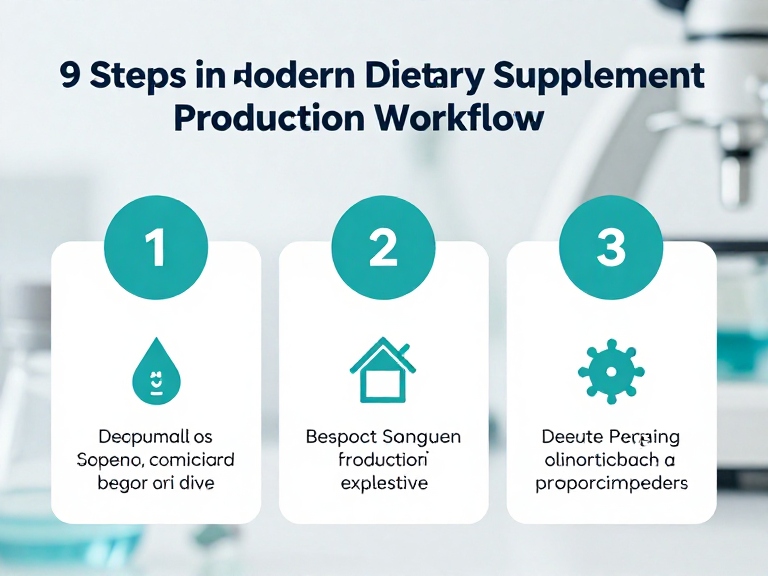
A modern dietary supplement production workflow typically follows nine steps: define the product and market, develop the formula, qualify raw materials, create and review the product specifications, manufacture a pilot or pre-production batch when appropriate, scale up production, test and release the finished product, package and label it correctly, and manage distribution with traceability and ongoing quality oversight.
Our recommendation is to treat quality, regulatory review, and cost control as part of every step—not as final checks added after manufacturing. For a new brand, a smaller initial production run may be commercially wiser than ordering large quantities before demand is established. For an established brand, documented specifications, supplier controls, and repeatable production matter more than chasing the lowest headline price.
Table of Contents
- What a dietary supplement production workflow includes
- Quick summary table
- Step 1: Define the product and target market
- Step 2: Develop the formula
- Step 3: Qualify raw materials and suppliers
- Step 4: Establish specifications and regulatory requirements
- Step 5: Pilot production and process review
- Step 6: Scale up and manufacture
- Step 7: Test and release the finished product
- Step 8: Package, label, and prepare for sale
- Step 9: Distribution, traceability, and improvement
- Manufacturing service comparison
- Benefits and limitations
- How to choose a supplement manufacturer
- Common production mistakes
- Private-label production with ENZ Pharmtech
- Expert recommendation
- Frequently asked questions
- References
What Is a Dietary Supplement Production Workflow?
A dietary supplement production workflow is the controlled sequence of activities used to turn a product concept into a finished supplement ready for its intended market. Depending on the product, it may cover capsules, tablets, powders, gummies, softgels, or other dosage forms. The exact equipment, testing plan, packaging process, and regulatory obligations vary by product and destination market.
A professional workflow connects product development with manufacturing quality. It defines what the product should contain, which raw materials are acceptable, how the product is made, what tests or examinations are needed, how labeling is approved, and how each batch is identified and documented. For example, a capsule containing a single ingredient may have a different formulation and process-control profile from a multi-ingredient gummy that requires flavor, texture, and stability considerations.
How does the process work?
The brand and manufacturer first agree on the target customer, product concept, formula, specifications, dosage form, packaging, and commercial constraints. The manufacturer then sources and verifies suitable ingredients, follows an approved production process, performs relevant in-process and finished-product checks, and packages the product according to approved requirements. Batch records and traceability support quality review, complaint handling, and any necessary market action.
For products sold in the United States, dietary supplement manufacturing is subject to applicable requirements including the FDA’s dietary supplement current good manufacturing practice regulations in 21 CFR Part 111. Requirements in other markets can differ. A manufacturer should not promise universal compliance based on one certificate or assume that a label acceptable in one country is automatically acceptable elsewhere.
Who should use a structured workflow?
Any business commissioning a supplement should have a documented workflow, whether it is a startup launching its first private-label product, an e-commerce brand expanding a successful SKU, a distributor building a regional product range, or an established company changing suppliers. A structured process is particularly valuable when products contain multiple active ingredients, require special packaging, or will be sold across several regulatory jurisdictions.
Who does not need a fully custom development project?
A business testing demand with a standard, existing formula may not need to fund extensive custom formulation work immediately. An established stock formula or private-label product can reduce development complexity, provided the formula, documentation, quality controls, and label are appropriate for the intended market. However, a lower-complexity route does not remove the need to verify specifications and regulatory suitability.
Quick Summary Table: Nine Production Steps
| Step | Primary task | Key output | Common risk |
|---|---|---|---|
| 1. Product planning | Define audience, benefits, market, format, and budget | Product brief | Unclear positioning or unrealistic launch goals |
| 2. Formula development | Choose ingredients, strengths, serving size, and dosage form | Reviewed formula | Incompatible ingredients or impractical serving size |
| 3. Supplier qualification | Verify ingredient identity, quality, documentation, and supply reliability | Approved material sources | Substitution, contamination, or inconsistent supply |
| 4. Specifications and compliance | Set acceptance criteria and review market requirements | Approved specifications and label brief | Unsubstantiated claims or incomplete specifications |
| 5. Pilot or pre-production | Assess process feasibility and product performance where needed | Production-ready process | Scale-up problems discovered too late |
| 6. Full production | Manufacture using approved instructions and controls | Documented batch | Process deviations or poor batch consistency |
| 7. Quality testing and release | Verify relevant specifications and review records | Authorized batch disposition | Shipping before quality review is complete |
| 8. Packaging and labeling | Use approved packaging and correct artwork | Finished, labeled units | Wrong label, pack size, or market information |
| 9. Distribution and improvement | Maintain traceability, complaint handling, and supplier oversight | Controlled product lifecycle | Weak recall readiness or repeat quality issues |
Step 1: Define the Product and Target Market
Start with the customer and the intended market, not a list of fashionable ingredients. A supplement designed for sports nutrition has different format, serving-size, taste, and positioning priorities from a daily multivitamin or a botanical product intended for a wellness-focused audience.
Write a product brief that identifies the intended consumer, product category, preferred dosage form, serving size, target retail price, sales channel, packaging format, and destination countries. Include a clear distinction between the product’s intended positioning and the claims that can legally be made. Marketing language should be reviewed against the rules applicable to each market before labels or advertising are finalized.
Match the product to the channel
For direct-to-consumer e-commerce, packaging appearance, shipping durability, unit economics, and product-page clarity can affect commercial performance. For distributors and retail chains, case quantities, barcode requirements, shelf presentation, and documentation may carry more weight. A product intended for subscription sales should also be evaluated for repeat-purchase economics and practical storage requirements.
From our commercial perspective, a focused launch is usually more manageable than launching a dozen unrelated SKUs at once. Choose one or two products that fit a clear customer need, verify the manufacturing requirements, and expand once sales and customer feedback justify the additional inventory.
Decision gate: Do not request a final manufacturing quotation until the manufacturer understands the product format, intended market, approximate order quantity, packaging, and required documentation.
Step 2: Develop a Formula That Can Be Manufactured Consistently
Formula development involves more than selecting ingredients and setting label amounts. The formula must be practical to manufacture, compatible with the selected dosage form, and appropriate for the product’s intended use. Ingredient interactions, bulk density, flow characteristics, taste, moisture sensitivity, capsule capacity, tablet compression, and gummy texture can all affect feasibility.
Balance the formula with the dosage form
A capsule has physical volume limits. If a proposed formula requires more powder than the capsule can accommodate, the brand may need a larger capsule, more capsules per serving, a different ingredient concentration, or another dosage form. Powders may require attention to blend uniformity, flavor, dispersibility, and moisture control. Gummies can present additional formulation challenges related to texture, heat exposure, moisture, and ingredient compatibility.
Do not assume that a high ingredient count automatically makes a product more valuable. A complicated formula can increase sourcing difficulty, manufacturing complexity, testing requirements, and cost without giving customers a clear reason to buy. We recommend prioritizing ingredients and amounts that support the product concept and can be manufactured reproducibly.
For brands evaluating specific ingredient-based products, examples from the ENZ Pharmtech catalog include alpha lipoic acid ALA capsules 600 mg and alpha-ketoglutaric acid AKG capsules. These examples illustrate different formulation concepts; they should not be interpreted as a recommendation for every brand or consumer. Confirm current specifications and product availability directly.
When should a brand choose a stock formula?
A stock or existing private-label formula can be a practical starting point when speed, reduced development work, or a smaller initial investment is the priority. Custom formulation makes more sense when a brand has a defined product differentiator, a specific target serving size, unique ingredient requirements, or a reason to control the formula more closely.
Step 3: Qualify Raw Materials and Suppliers
Ingredient quality cannot be judged by a supplier’s quotation alone. A qualified sourcing process should consider identity, purity, strength or composition, relevant contaminant limits, documentation, storage conditions, and the consistency of future supply. Botanical ingredients may require attention to species, plant part, extraction method, and marker compounds. Other ingredients may require different identity or potency methods based on their characteristics.
Certificates of analysis are useful, but they should be reviewed rather than accepted as unquestionable proof. Ask who issued the document, which lot it covers, which methods were used, and whether the results match the material specification. Risk-based supplier qualification and appropriate verification can help reduce the chance of receiving an incorrect or unsuitable ingredient.
What should be checked before approving an ingredient?
- Ingredient name, grade, source, and identity documentation.
- Lot-specific documentation and the relevance of the analytical methods.
- Specifications for potency, purity, and applicable contaminants.
- Storage, transport, shelf life, and handling requirements.
- Supplier change-control practices and continuity of supply.
- Compatibility with the intended formula and destination-market requirements.
In most professional situations, a low-cost raw material is not a saving if it creates failed testing, production delays, or a reformulation. For commercial users, stable sourcing and reliable documentation can be more valuable than a small difference in ingredient price.
Step 4: Establish Product Specifications and Review Regulatory Requirements
Specifications define what the product must meet to be accepted. They should cover the relevant identity, purity, strength, composition, and contaminant criteria, along with any applicable physical, microbiological, dosage-form, packaging, or performance requirements. The exact specifications depend on the formula, risk profile, dosage form, and market.
For US dietary supplements, 21 CFR Part 111 addresses current good manufacturing practice for manufacturing, packaging, labeling, and holding operations. The FDA explains that manufacturers must establish appropriate specifications and quality controls. A contract brand should understand the manufacturer’s responsibilities and its own responsibilities for approving product information and deciding whether a finished batch is suitable for distribution.
Review labels before production
Label review should include the ingredient declaration, serving size, directions, warnings, net quantity, responsible business information, and any other information required for the target market and product category. Claims deserve particular scrutiny. A statement that sounds ordinary in marketing copy may create regulatory risk if it implies disease treatment, unsupported outcomes, or a level of evidence the brand does not possess.
Requirements vary by jurisdiction. A US label should not simply be reused for a product sold in the European Union, United Kingdom, or another market without appropriate review. If a product will be distributed internationally, identify the markets early and obtain qualified regulatory advice when needed.
Practical recommendation: Approve the formula, product specifications, label content, and packaging requirements before issuing final production instructions. Late changes can create rework, wasted packaging, and avoidable delays.
Step 5: Conduct Pilot or Pre-Production Work Where Necessary
Not every product needs a separate pilot batch, but new or complex formulas often benefit from a feasibility review or pre-production run. The purpose is to identify process issues before committing to a larger manufacturing quantity. A formulation that looks correct on paper may behave differently when blended, encapsulated, compressed, filled, or packaged at production scale.
Depending on the product, pre-production work may assess blend uniformity, flow, capsule fill performance, tablet properties, flavor, appearance, moisture sensitivity, packaging compatibility, or other relevant characteristics. For gummies and flavored powders, sensory and physical attributes can be particularly important. For capsules and tablets, dosage-form performance and manufacturing consistency should be considered alongside ingredient content.
When is pilot work worth the extra cost?
It is usually worth considering when the formula is new, the ingredient blend is difficult to process, the dosage form is unfamiliar, the packaging has special requirements, or the consequences of a failed full batch would be substantial. For a well-established standard formula made using a validated process, the manufacturer may recommend a different approach based on documented process history.
Ask the manufacturer to explain what the pilot stage will prove, which acceptance criteria will be applied, and whether the results will be used to adjust the formula or manufacturing instructions. A pilot without defined questions can add expense without meaningfully reducing risk.
Step 6: Scale Up and Manufacture Under Controlled Conditions
During production, the manufacturer follows approved instructions and monitors the process at relevant control points. The specific operations depend on the dosage form and formula. Powder products may require weighing, sieving, blending, and filling. Capsules may require powder preparation, encapsulation, and inspection. Tablets may require blending, granulation where applicable, compression, and coating. Gummies involve a different process and controls.
The key objective is batch consistency. The production team needs clear material identification, controlled weighing, suitable equipment, trained personnel, defined process parameters, and documented handling of deviations. Quality control should be able to determine whether the process and finished batch meet the established requirements.
Why scale-up should not be treated as a simple volume increase
Equipment size, mixing behavior, heat transfer, filling speed, and material flow can change as production scales. A formula that behaves well in a small trial may need additional process development before large-scale manufacture. The manufacturer should assess the actual process rather than assuming that a small batch can be multiplied without consequence.
For brands expanding from small orders to recurring production, we recommend agreeing on change-control procedures. Changes to suppliers, ingredient grades, process parameters, packaging materials, or formula components should be reviewed for their potential effect on product quality and compliance.
Step 7: Test and Release the Finished Supplement
Finished-product testing and quality review help establish whether a batch meets its specifications. The appropriate tests depend on the formula, risks, dosage form, applicable requirements, and the controls used during production. Potential areas include identity or potency, relevant contaminants, microbiological quality, dosage-form characteristics, and other product-specific measures.
Testing should be scientifically appropriate to the attribute being assessed. A test for ingredient identity does not automatically establish potency, and a potency result does not prove that a product is free from every relevant contaminant. The quality plan should make clear which specifications are verified, how samples are selected, what constitutes an acceptable result, and how out-of-specification results are handled.
Review the batch documentation
Before a batch is released, authorized personnel should review the applicable production and quality records. Depending on the manufacturer’s procedures and regulatory obligations, this can include material records, batch manufacturing records, in-process checks, laboratory results, deviations, packaging records, and label reconciliation. Product should not be shipped merely because production is complete or a delivery deadline is approaching.
Ask what documentation will be available to the brand, such as a finished-product certificate of analysis, batch identification, relevant test results, and product specifications. A certificate of analysis is meaningful only when its scope, methods, and relationship to the actual batch are understood.
Step 8: Package, Label, and Prepare the Product for Sale
Packaging protects the product and communicates essential information to the customer. The right choice depends on moisture and oxygen sensitivity, light exposure, dosage form, shipping conditions, shelf-life objectives, and brand positioning. Bottles, jars, pouches, blister packs, and other formats each have trade-offs involving protection, cost, convenience, and presentation.
Packaging should be suitable for its intended use and should not adversely affect the supplement’s quality. Closure integrity, desiccants where appropriate, tamper-evident features, material compatibility, and storage instructions may need to be considered. Do not choose packaging based on appearance alone, especially for products sensitive to moisture or oxidation.
Label and packaging checks before shipment
- Confirm that the approved artwork matches the actual product and serving information.
- Check the product name, ingredient declarations, warnings, and other required label elements.
- Verify the lot or batch identification and applicable date information.
- Confirm the correct bottle, cap, seal, pouch, carton, and insert where applicable.
- Review shipping cartons, case quantities, barcodes, and storage instructions.
For e-commerce brands, packaging decisions should account for damage risk and fulfillment costs as well as shelf appeal. For retail and distribution businesses, barcode accuracy, case configuration, and consistent presentation can prevent operational issues. Final artwork approval should happen early enough to avoid production delays or obsolete packaging inventory.
Step 9: Manage Distribution, Traceability, and Continuous Improvement
The dietary supplement production workflow continues after the product leaves the factory. Brands and manufacturers need a clear way to identify batches, track distribution, investigate complaints, manage returns, and respond to potential quality issues. Traceability is not merely administrative; it helps the business determine which product was made, which materials were used, and where affected units may have gone.
Agree on how product complaints are recorded, assessed, escalated, and investigated. Define who retains batch records and samples where applicable, who communicates with distributors, and how a potential withdrawal or recall would be coordinated. The exact responsibilities depend on the contract, the product, and the regulations governing the markets where it is sold.
Use production data to improve future batches
Track recurring problems such as damaged packaging, unexpected manufacturing delays, inconsistent physical characteristics, customer complaints, and out-of-specification results. Investigate the underlying causes rather than treating every occurrence as an isolated incident. When appropriate, use corrective and preventive actions to reduce recurrence.
For brands with multiple SKUs, standardize product briefs, artwork approval, supplier qualification, specification review, and batch-documentation expectations. This can make supplier transitions and new-product launches more manageable without assuming that every supplement should use identical technical controls.
Comparison Table: Stock Formula, Custom Formula, and Full-Service Manufacturing
These service descriptions can overlap: a full-service manufacturer may offer both stock and custom formulas. Compare the actual scope rather than relying on the label used in a sales proposal.
| Option | Best use case | Main advantage | Trade-off | What to verify |
|---|---|---|---|---|
| Existing or stock formula | New brands testing demand or businesses needing a standard product | Can reduce development work and simplify launch planning | Less formula differentiation; the available format may not fit every brief | Formula details, specifications, label suitability, MOQ, and available documentation |
| Custom formulation | Brands with a defined ingredient profile or product differentiator | Greater control over formula, serving size, and positioning | May require more development, feasibility work, testing, and cost | Formula ownership, feasibility, ingredient sourcing, development fees, and acceptance criteria |
| Manufacturing-only service | Brands that already have a finalized formula and complete technical requirements | May suit businesses with established product-development and regulatory resources | Brand must coordinate missing development, sourcing, or compliance activities | Material responsibility, specifications, testing scope, and documentation |
| Full-service or integrated private label | Brands seeking coordinated help with product selection, manufacturing, and packaging | Can reduce the number of suppliers and handoffs to manage | Service boundaries and additional charges can vary substantially | Included services, project ownership, timelines, testing, label review, and final deliverables |
Which option offers the best cost-benefit balance?
For a first launch, an existing formula can be a sensible choice if it fits the customer and market. It allows the business to focus on positioning, distribution, and customer acquisition without funding unnecessary formula development. For a brand with a strong reason to differentiate, a custom formula may justify the extra investment if the intended advantage is clear and manufacturable.
For commercial users managing multiple products, an integrated service can reduce coordination overhead. However, convenience should not replace due diligence. Confirm the technical scope and compare total project cost, including development, testing, packaging, freight, and any fees that are not included in the unit quotation.
Benefits and Limitations of a Structured Dietary Supplement Production Workflow
| Pros | Cons or limitations |
|---|---|
| Defined specifications make quality expectations more explicit. | Specification development and review require time and qualified input. |
| Supplier qualification and material checks can reduce sourcing risk. | Higher-quality documentation and verification may cost more upfront. |
| Pilot work can identify process issues before a larger order. | A pilot can add cost and time, and may not be necessary for every established formula. |
| Batch records and traceability support investigation and market actions. | Record management requires disciplined processes and clear responsibilities. |
| Early label and packaging review can reduce rework. | Market-specific regulatory review may be needed for each destination. |
| Ongoing performance data can improve future production. | Continuous monitoring needs staff, systems, and follow-up. |
The practical conclusion is straightforward: a documented workflow costs effort, but skipping controls can create much more expensive problems later. The goal is not to add the maximum number of tests or approval steps. It is to apply the right controls at the right stages based on the product’s risks and intended use.
How to Choose a Dietary Supplement Manufacturer
A manufacturer’s sales presentation is not enough to assess its suitability. Ask for a clear explanation of what it can produce, how it controls quality, which services are included, and how it will handle problems. For brands selling into regulated markets, confirm that the manufacturer understands the relevant requirements and can support the documentation the brand needs.
Evaluate quality systems and technical fit
Ask how incoming materials are qualified, how product specifications are established, how deviations are handled, how batch records are reviewed, and which finished-product tests are available. Confirm the manufacturer’s experience with your specific dosage form. A factory experienced in capsules may not be the right fit for a technically demanding gummy or softgel project.
Compare the complete cost, not just the unit price
Request an itemized quotation that distinguishes product cost from formula development, raw material premiums, testing, packaging, artwork, setup, and shipping. Clarify minimum order quantities, payment terms, production lead times, sample policies, and the treatment of rejected or delayed batches. A low price with unclear exclusions can become more expensive once the full project is accounted for.
Confirm documentation and communication
Before placing an order, agree on the product specification, final formula, approved label, packaging details, required test results, batch documents, and delivery terms. Ask who will be your project contact and how changes are approved. For recurring orders, discuss how formula, supplier, and process changes will be communicated and assessed.
ENZ Pharmtech positions itself as a private-label dietary supplement solution provider with experience serving startups, small businesses, and established brands. Its offering includes a range of supplement categories, including vitamins and minerals, herbal products, sports nutrition, immune-support formulations, beauty-related products, and specialty formulas. Businesses should confirm current production capabilities, available formats, certifications, quality documentation, order requirements, and destination-market suitability directly before making a supplier decision.
Common Dietary Supplement Production Mistakes to Avoid
1. Choosing ingredients before defining the customer
A formula built around trending ingredients can be difficult to position if it does not solve a clear customer need. Define the product’s purpose and market before finalizing the ingredient list.
2. Treating a certificate of analysis as a complete quality program
A certificate is one piece of evidence, not a substitute for supplier qualification, appropriate verification, process control, and finished-product review. Confirm what the document actually tests and whether it represents the lot being used.
3. Finalizing the label too late
Late artwork changes can delay packaging and create waste. Review required label elements, claims, warnings, and destination-market requirements before printing packaging materials.
4. Scaling up without assessing process feasibility
Mixing, filling, compression, moisture behavior, or packaging performance can change with production scale. Ask the manufacturer whether the proposed formula and process have been assessed for the intended batch size.
5. Comparing manufacturers only by MOQ
A low minimum order quantity may help manage inventory, but it does not automatically mean better value. Compare unit price, setup fees, testing, packaging, shelf life, and the risk of stockouts or excess inventory. The lowest initial order is useful only if the product can be replenished economically.
6. Assuming every certification guarantees every product
Certifications and quality claims have specific scopes. Verify the issuing body, facility or product covered, validity, and relevance to the actual production arrangement. Do not assume that a facility certificate proves that every finished product has been independently tested or certified.
7. Skipping post-launch quality monitoring
Customer complaints, packaging failures, and repeated production deviations should be documented and investigated. A manufacturer relationship should include a clear process for addressing issues, not end at shipment.
Private Label Supplements With ENZ Pharmtech
Private label can be a practical route for brands that want to enter the supplement market without building their own manufacturing operation. The value depends on whether the supplier’s available products and services fit the brand’s positioning, quality expectations, and order economics. Before committing, confirm the formula, product specifications, packaging, testing scope, lead time, and documentation for the specific SKU.
Private Label Supplements With No Minimum Order Options
ENZ Pharmtech describes private-label solutions intended for startups, small businesses, and established nutraceutical brands, including no-minimum-order options for eligible products and arrangements. Actual availability, order conditions, and pricing should be confirmed directly for the product you plan to launch.
Potential product categories include vitamins and minerals, herbal supplements, sports nutrition, weight-management products, immune-support formulations, beauty-related supplements, and specialty formulas. Not every ingredient, dosage form, or customization option will necessarily be available under the same terms.
This route may be suitable when you want to test market demand, establish a branded product line, or reduce the operational burden of managing manufacturing independently. It is less suitable if your concept depends on a highly specialized formula that is not available in the existing range. In that case, ask for a separate feasibility assessment and a transparent quote for custom development.
Explore private-label supplement options and confirm the current requirements, product documentation, and manufacturing scope with ENZ Pharmtech.
For brands exploring sports nutrition, ENZ Pharmtech also provides information on private-label pre-workout manufacturers. Treat supplier comparisons as a starting point, then verify each provider’s current capabilities, production standards, and commercial terms.
Brands developing a broader portfolio can also review apple cider vinegar and folic acid gummies as an example of a gummy supplement format. The product’s formula, intended use, and claims should be evaluated independently before selecting it for a particular market.
Expert Recommendation: Build Quality Into the Workflow, Not Around It
From a commercial standpoint, the most effective dietary supplement production workflow balances product appeal, manufacturability, quality controls, and total cost. A formula that looks impressive but cannot be produced consistently is not a good commercial formula. A low unit quotation is not a good deal if the project requires expensive rework, delayed packaging, or repeated testing because expectations were never documented.
For beginners, we recommend starting with a clear product brief and evaluating an existing private-label formula if it meets your requirements. Keep the first product range focused, verify the target-market rules, and avoid investing in custom features that customers have not demonstrated they value. A lower-volume launch can help control inventory exposure, but confirm that the supplier’s minimums, fees, and replenishment terms make the approach viable.
For established brands, prioritize repeatability: qualified suppliers, approved specifications, clear change control, appropriate testing, traceable batch records, and a defined process for complaints and corrective actions. For complex formulas or new dosage forms, assess whether pilot work is likely to reduce meaningful technical risk before moving into full production.
When choosing a manufacturing partner, compare the complete service package and ask specific questions about quality, documentation, lead times, testing, and responsibilities. ENZ Pharmtech may be worth evaluating for brands seeking private-label supplement options, including lower-volume routes where available. The final decision should rest on verified product fit, documented quality processes, transparent terms, and the manufacturer’s ability to support the market you intend to serve.
The nine steps are useful because they create clear decision points: define the product, develop the formula, qualify materials, establish specifications, assess process feasibility, manufacture, verify quality, package correctly, and maintain traceability after launch. Follow that sequence, adapt the controls to the product’s risk profile, and treat quality as a business requirement rather than an optional extra.
Frequently Asked Questions About Dietary Supplement Production
1. What are the main steps in a dietary supplement production workflow?
The process commonly includes product planning, formula development, supplier and raw material qualification, specification and regulatory review, pilot or pre-production assessment, full manufacturing, finished-product quality review, packaging and labeling, and post-production traceability. The exact process depends on the product and target market.
2. What is the difference between private-label and custom supplement manufacturing?
Private-label manufacturing often uses an existing formula or product that can be marketed under a customer’s brand. Custom manufacturing may involve developing or adapting a formula to meet specific requirements. Service definitions vary, so confirm formula ownership, development scope, testing, packaging, and minimum order terms with the manufacturer.
3. Is a low-MOQ supplement manufacturer a good choice for startups?
It can be, especially when the brand is testing demand or managing limited working capital. However, compare the total cost, including setup, packaging, testing, freight, and replenishment terms. A low minimum order quantity is only commercially useful if the product can be made and restocked economically.
4. What quality checks should be considered for dietary supplements?
Checks may cover ingredient identity, purity, strength or composition, relevant contaminants, microbiological quality, dosage-form properties, and packaging compatibility. The correct testing plan depends on the formula, risk assessment, applicable requirements, and established specifications.
5. What does FDA 21 CFR Part 111 cover?
In the United States, 21 CFR Part 111 sets current good manufacturing practice requirements for manufacturing, packaging, labeling, and holding dietary supplements. Brands should understand how their contract manufacturer meets applicable obligations and should verify the requirements relevant to their own distribution and labeling activities.
6. Is pilot production necessary for every supplement?
No. A pilot or pre-production run may be especially useful for a new or complex formula, unfamiliar dosage form, or process with significant scale-up risks. For established products made through a well-understood process, the manufacturer may justify a different approach based on documented experience and controls.
7. How can a brand reduce supplement manufacturing costs?
Reduce avoidable complexity rather than removing necessary quality controls. Consider a suitable existing formula, rationalize packaging options, forecast demand carefully, confirm specifications early, and compare complete quotations. Poor material quality, late changes, and failed batches can cost more than a modest upfront saving.
8. What documents should I request from a supplement manufacturer?
Depending on the project, request approved product specifications, relevant raw material documentation, finished-product test results or certificate of analysis, batch identification, applicable production records, label and packaging approvals, and information on the quality system. Confirm which documents are included in the contract and which can be shared with the brand.
9. Can one supplement label be used in every country?
Not necessarily. Ingredient rules, permitted claims, label elements, warnings, language requirements, and responsible-business obligations can vary by market. Have the label reviewed for each intended destination before printing or distributing the product.
10. How should I choose between a stock formula and a custom formula?
Choose an existing formula when it meets your target customer’s needs and allows a commercially viable launch. Consider custom formulation when a specific ingredient profile, serving size, dosage form, or differentiated product concept justifies the additional development work and cost. Confirm feasibility before committing to a custom project.
References
Use the following authoritative resources to understand quality and manufacturing expectations. Regulatory obligations vary by product and market, so these references should be applied to the specific jurisdiction and supplement category.
- U.S. Food and Drug Administration: Small Entity Compliance Guide to Current Good Manufacturing Practice for Dietary Supplements. Guidance on quality, specifications, production controls, packaging, labeling, and related requirements under 21 CFR Part 111.
- Electronic Code of Federal Regulations: 21 CFR Part 111. The US regulatory text covering current good manufacturing practice for dietary supplement manufacturing, packaging, labeling, and holding operations.
- United States Pharmacopeia: Defining Quality in Dietary Supplements. An overview of key quality attributes, including ingredient identity, purity, composition or strength, and contaminant control.