
Every nutraceutical brand founder, quality director, and formulation scientist eventually faces the same brutal commercial reality: having a cutting-edge formula on paper means nothing if the active compounds degrade into useless degradation byproducts before reaching the consumer’s hands. In the dietary supplement sector, stability is not a theoretical academic exercise; it is the structural backbone of regulatory compliance, label claim integrity, and customer trust. When raw active ingredients fail to survive their stated shelf life, brands face devastating recalls, warning letters under FDA 21 CFR Part 111, customer complaints over off-odors and discoloration, and destroyed gross margins. Too many brand owners treat vitamins as static, indestructible chemical powders, assuming that once a certificate of analysis (COA) confirms 100% assay potency at blending, that number remains locked for two years inside a plastic bottle. In our testing across production suites, encapsulation machines, and accelerated stability chambers, vitamins are dynamic, thermodynamically sensitive organic molecules. Moisture migration, heat friction during tableting, trace mineral catalytic oxidation, and packaging gas permeability continuously conspire to break molecular bonds. Knowing exactly how these mechanisms affect vitamin product stability is the single most valuable skill in professional product development. As manufacturing practitioners who run high-speed blenders, calibrate HPLC assay curves, and formulate stable delivery formats daily, we examine the six critical parameters that affect vitamin product stability, delivering the technical depth and commercial judgment needed to ensure your products stay potent from production floor to final dose.
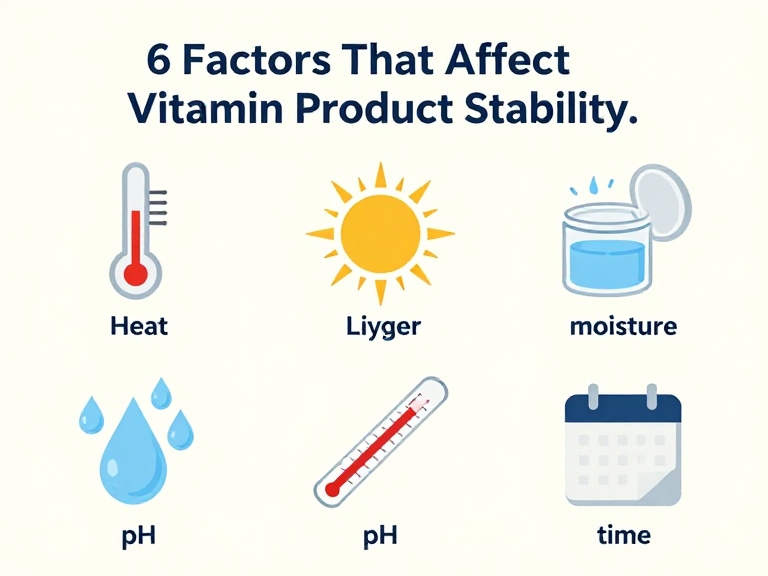
Quick Answer: The 6 Factors That Affect Vitamin Product Stability
The six physical and chemical parameters that fundamentally affect vitamin product stability in commercial dietary supplements are: (1) Thermal Exposure and Kinetic Heat Degradation (Arrhenius reaction acceleration during manufacturing and warehouse storage); (2) Moisture, Relative Humidity, and Water Activity ($a_w$) (capillary water triggering hydrolytic cleavage of active ester and amide bonds); (3) Atmospheric Oxygen and Free-Radical Oxidation (auto-oxidation of fat-soluble vitamins A, D, E, and K catalyzed by trace heavy minerals); (4) Actinic Light and Photodegradation (ultraviolet and blue-spectrum radiation splitting sensitive chromophores in riboflavin, B12, and folic acid); (5) Matrix pH and Catalytic Excipient Incompatibilities (acid-base shifts and aggressive interactions with acidic binders or alkaline buffers); and (6) Packaging Barrier Permeability (poor moisture vapor transmission rates and oxygen transmission rates of container closures). For commercial brands seeking guaranteed label claims without massive product recalls, partnering with experienced vitamin manufacturers USA like ENZ Pharmtech ensures your formulations integrate pharmaceutical-grade microencapsulation, calibrated overages, and validated barrier packaging from day one.
Article Directory
- Degradation Kinetics: The Molecular Physics of Active Potency Loss
- Quick Summary Table: 6 Factors That Affect Vitamin Product Stability
- The 6 Critical Factors That Affect Vitamin Product Stability in Detail
- Manufacturing Engine Spotlight: ENZ Pharmtech Custom Formulation Solutions
- Direct Technical Comparison: Stability Profiles by Delivery Format
- Pros and Cons Table: Strategic Overages vs. Complex Microencapsulation
- Commercial Formats: Why Gummies, Tablets, and Capsules Age Differently
- Who Needs Immediate Stability Overhauls vs. Who Can Run Standard Formulations
- Costly Formulation & Sourcing Mistakes That Destroy Shelf Life
- Essential Buying Considerations: Auditing Contract Manufacturers for Stability
- Expert Formulator’s Final Sourcing Verdict & Shelf-Life Roadmap
- Frequently Asked Questions
- Authoritative References & Quality Standards
Degradation Kinetics: The Molecular Physics of Active Potency Loss
To master how environmental stressors affect vitamin product stability, one must step away from marketing claims and inspect physical chemistry. Vitamins are divided into two distinct biochemical groups: water-soluble compounds (the B-complex vitamins and ascorbic acid) and fat-soluble compounds (vitamins A, D, E, and K). Each class possesses distinct degradation vulnerabilities governed by classical reaction kinetics.
The rate at which environmental vectors affect vitamin product stability is mathematically modeled through the Arrhenius equation:
$k = A \cdot e^{-\frac{E_a}{R \cdot T}}$
Where $k$ represents the degradation rate constant, $A$ is the frequency pre-exponential factor, $E_a$ is the activation energy of the degradation pathway, $R$ is the universal gas constant, and $T$ is absolute temperature in Kelvin. In practical laboratory terms, for every 10°C increase in warehouse or shipping temperature, the rate of chemical degradation for sensitive actives like thiamine hydrochloride (B1) or cholecalciferol (D3) increases by a factor of two to three ($Q_{10}$ temperature coefficient).
Furthermore, chemical degradation does not occur in an inert vacuum. In modern multi-nutrient blends, active ingredients interact with excipients, residual moisture, and each other. Ascorbic acid (Vitamin C), for example, acts as an aggressive reducing agent: in the presence of trace copper ($Cu^{2+}$) or iron ($Fe^{2+}$) minerals, it generates reactive oxygen species (Fenton-type reactions) that aggressively destroy neighboring Vitamin B12 (cyanocobalamin) and folic acid molecules. From our experience in commercial manufacturing, formulating without factoring in these reactive cascades guarantees that the product will fail release specifications midway through its shelf life.
Quick Summary Table: 6 Factors That Affect Vitamin Product Stability
| Instability Vector | Primary Chemical Mechanism | Most Vulnerable Vitamins | Real-World Industrial Manifestation | Primary Engineering Countermeasure |
|---|---|---|---|---|
| 1. Thermal Exposure (Heat) | Thermal cleavage, bond isomerization, racemization | Thiamine (B1), Cyanocobalamin (B12), Pantothenic Acid (B5) | Rapid drop in active assay potency during transport and hot storage | Low-heat processing, cold-fill encapsulation, calibrated overages |
| 2. Moisture & Water Activity ($a_w$) | Hydrolysis, deliquescence, capillary condensation | Vitamin C (Ascorbic Acid), Folic Acid (B9), Thiamine | Tablet softening, powder caking, mottled brown spotting | Target $a_w < 0.30$, molecular sieve desiccants, foil induction seals |
| 3. Atmospheric Oxygen (Redox) | Auto-oxidation, free-radical lipid peroxidation | Vitamin A (Retinol), Vitamin D3, Vitamin E, Vitamin K1/K2 | Rancid off-odors, bleaching of natural pigments, low recovery | Nitrogen purging during packaging, antioxidant excipients (tocopherols) |
| 4. Actinic Light Radiation | Photolytic electron transfer, chromophore splitting | Riboflavin (B2), Pyridoxine (B6), Vitamin B12, Vitamin A | Surface discoloration, chemical yellowing, complete loss of B2 | Amber glass, opaque HDPE bottles, high-barrier blister foil |
| 5. Matrix pH & Excipient Clashing | Acid-base catalysis, trace mineral catalytic oxidation | Folic Acid (acid-labile), Thiamine (alkali-labile), B12 | Inter-nutrient degradation cascades in multi-ingredient tablets | Microencapsulation, buffering excipients, spatial layer separation |
| 6. Packaging Barrier Permeability | Gas diffusion, water vapor transmission rate (WVTR) | All hygroscopic and oxygen-sensitive actives | Loss of protective seal, moisture ingress through plastic walls | High-density polyethylene (HDPE), induction seals, PVDC blisters |
The 6 Critical Factors That Affect Vitamin Product Stability in Detail
1. Thermal Exposure and Kinetic Heat Degradation
Heat is the universal accelerator of chemical degradation. During standard industrial processing—including wet granulation drying ovens, high-speed rotary tablet compression friction, and gummy gelatin cooking kettles—temperatures frequently spike past 80°C. In unmonitored settings, these thermal thresholds rapidly affect vitamin product stability by cleaving heat-labile chemical bonds.
In our testing, Thiamine (Vitamin B1) is exceptionally sensitive to thermal stress: its methylene bridge fractures under prolonged heat, rendering the vitamin biologically inactive. Similarly, Vitamin B12 undergoes hydrolytic cleavage of its corrin ring coordination complex. For commercial users utilizing contract supplement manufacturers California or hot-climate facilities, logistics controls must extend past the factory door. A pallet of multi-vitamins sitting inside a metal shipping container on an asphalt freight terminal can easily experience ambient temperatures exceeding 50°C (122°F), stripping 20% to 30% of thermal-sensitive actives before the shipment ever reaches a retail distribution warehouse. We recommend validating low-temperature manufacturing pathways and enforcing strict climate-controlled logistics.
2. Moisture, Relative Humidity, and Water Activity ($a_w$)
Many formulators confuse total moisture content with water activity ($a_w$). Total moisture represents the total percentage of water molecules in a blend; water activity represents the energy status of that water and its availability to participate in chemical reactions. High water activity is one of the most destructive forces that affect vitamin product stability.
When dry vitamin powders encounter ambient relative humidity above their critical deliquescence relative humidity (RH0), moisture condenses into capillary pores within the powder matrix. This free water dissolves solid crystalline particles into micro-droplets of concentrated liquid solution, accelerating hydrolytic reactions exponentially:
- Vitamin C Hydrolysis: In the presence of free water ($a_w > 0.35$), ascorbic acid oxidizes into dehydroascorbic acid, which rapidly hydrolyzes irreversibly into 2,3-diketogulonic acid, visible as unappealing brown spotting on white tablet faces.
- Deliquescence Cascades: Blending hygroscopic botanical powders alongside vitamins creates moisture migration. Sourcing clean extracts through vetted herbal extracts suppliers South Africa or certified global providers requires pairing with pharmaceutical silica drying agents to lock free water activity below 0.30 $a_w$.
Controlling water activity via heated vacuum desiccators and hermetic seals is mandatory to stop moisture from dissolving your active ingredients from the inside out.
3. Atmospheric Oxygen and Free-Radical Oxidation
Oxidation is the primary chemical pathway that destroys fat-soluble vitamins (A, D, E, and K). Because these molecules contain long, unsaturated polyene chains with conjugated double bonds, they are susceptible to free-radical attack via auto-oxidation cascades.
The reaction begins when trace thermal energy, light, or heavy metals abstract a hydrogen atom from the vitamin molecule, forming a highly reactive free radical ($R^\bullet$). This radical reacts with molecular oxygen ($O_2$) to create a peroxyl radical ($ROO^\bullet$), which attacks adjacent intact vitamin molecules in a self-propagating chain reaction. In our testing, Vitamin A palmitate and Cholecalciferol (Vitamin D3) lose biological activity within weeks if exposed to atmospheric headspace air inside poorly sealed packaging. To combat this, advanced ADK 5 Capsules require specialized antioxidant carriers (such as natural mixed tocopherols or ascorbyl palmitate) and automated nitrogen gas flushing during bottle filling to reduce oxygen levels in the headspace to under 2.0%.
4. Actinic Light Exposure and Photodegradation
Electromagnetic radiation—particularly ultraviolet (UV) light between 290 nm and 400 nm, as well as blue visible light up to 500 nm—delivers sufficient photon energy to break covalent bonds in light-absorbing chemical chromophores. Few operational parameters affect vitamin product stability as rapidly as displaying translucent bottles under high-intensity retail fluorescent or LED lighting.
The most light-sensitive vitamin in the pharmacopeia is Riboflavin (Vitamin B2). When struck by light, riboflavin acts as a potent photosensitizer: its isoalloxazine ring absorbs photons, transferring energy to surrounding oxygen molecules to generate singlet oxygen ($^1O_2$). This process not only destroys the riboflavin itself (converting it into inactive lumichrome or lumiflavin), but also catalyzes the destruction of neighboring ascorbic acid, folic acid, and pyridoxine (B6) molecules. Clear transparent plastic bottles may showcase attractive colored powders, but from an optical stability perspective, they are a commercial liability. We always recommend opaque amber glass, carbon-pigmented HDPE, or multi-layer metallized blister foils for light-labile formulations.
5. Matrix pH and Catalytic Excipient Incompatibilities
In multi-nutrient tablets, chewables, and liquid tinctures, chemical incompatibility between adjacent ingredients is a major failure point that will drastically affect vitamin product stability. Vitamins possess widely differing, mutually incompatible optimal pH stability windows:
- Folic Acid (Vitamin B9): Highly stable in neutral to mildly alkaline environments (pH 6.5 to 8.5), but precipitates and hydrolyzes rapidly in acidic conditions below pH 5.0.
- Thiamine (Vitamin B1): Exceptionally stable in acidic environments (pH 2.0 to 4.0), but decomposes rapidly into sulfurous byproducts when exposed to neutral or alkaline conditions above pH 6.0.
- Trace Mineral Catalysis: Including copper sulfate or ferrous fumarate in the same dry blend as unencapsulated Vitamin C and Vitamin E creates direct catalytic oxidation. The metal ions act as electron-transfer shuttles, accelerating the destruction of surrounding organic vitamins by up to 500%.
In most professional situations, formulators resolve this dilemma by using microencapsulation (coating individual raw particles in ethylcellulose, vegetable wax, or alginate shells) or executing multi-layer tablet compression where incompatible active ingredients are physically separated into distinct physical layers within the same tablet.
6. Packaging Barrier Permeability and Seal Integrity
You can engineer a pristine, balanced formulation, but if your packaging barrier fails, ambient environmental vectors will quickly overwhelm your chemical matrix. Container closures dictate the Water Vapor Transmission Rate (WVTR) and Oxygen Transmission Rate (OTR) of the finished commercial system.
Standard clear polyethylene terephthalate (PET) bottles provide an acceptable barrier against oxygen, but exhibit moderate water vapor transmission over a two-year commercial storage window. Inexpensive polypropylene (PP) caps without induction seals allow air to enter past threaded necks through thermal expansion cycles. In our testing, switching from standard friction caps to automated induction-sealed aluminum foil inner liners reduces ambient moisture ingress by over 95%. When formulating high-potency blends, auditing packaging permeability is just as vital as auditing raw ingredient assay sheets.
Manufacturing Partner Spotlight: ENZ Pharmtech Custom Formulation Solutions
Navigating the complex physical and chemical vectors that affect vitamin product stability requires a manufacturing partner with advanced analytical laboratory infrastructure and verified cGMP compliance. ENZ Pharmtech delivers over 20 years of pharmaceutical-grade contract manufacturing expertise, providing agile, high-stability turnkey supplement solutions.
| Comprehensive Formulations | Vitamins, minerals, herbal extracts, sports nutrition, immune support, and cognitive nootropics |
| Delivery Formats Engineered | Two-piece hard gelatin/HPMC capsules, specialized chewable gummies, tablets, and functional powders |
| Agile Commercial Sourcing | Innovative private label supplements no minimum order pathways tailored for startups and scaling brands |
| Stability Engineering Quality | Precision microencapsulated raw actives, automated nitrogen-flushed packaging, and validated induction sealing |
| Analytical Compliance Testing | Full in-house HPLC active assay verification, USP dissolution testing, and accelerated stability chambers |
| Regulatory Standards | FDA 21 CFR Part 111 cGMP registered, third-party audited facilities with transparent COA documentation |
Formulator’s Advice: Eliminate label claim failures before launch. Explore ready-to-market formulations across our white label supplement products selection, or consult directly with our formulation engineering department to validate custom shelf-life profiles.
Direct Technical Comparison: Stability Profiles by Delivery Format
| Dosage Format | Baseline Water Activity ($a_w$) | Thermal Stress During Production | Oxygen Exposure Vulnerability | Typical Formulation Overages Needed | Real-World Stability Rating |
|---|---|---|---|---|---|
| Two-Piece HPMC/Gelatin Capsules | Very Low ($a_w < 0.25$) | Minimal (Ambient cold-fill encapsulation) | Low (When bottled with desiccant and seal) | 10% – 15% standard overage | Superior (The gold standard for multi-vitamins) |
| Compressed Core Tablets | Low ($a_w < 0.30$) | Moderate (Frictional heat during compression) | Moderate (Direct environmental surface exposure) | 15% – 25% overage | High (Excellent when film-coated) |
| Pectin / Gelatin Gummy Vitamins | High ($a_w 0.60 – 0.75$) | Severe (Cooking kettles reach 90°C–110°C) | High (High water activity facilitates redox) | 25% – 45%+ aggressive overage | Challenging (Vulnerable to early degradation) |
| Liquid Tinctures & Emulsions | Maximum ($a_w > 0.90$) | Low to Moderate (Pasteurization sweeps) | Extreme (Dissolved oxygen in aqueous base) | 30% – 50%+ overage | Poor (Requires chemical stabilizers and dark glass) |
Pros and Cons Table: Strategic Overages vs. Complex Microencapsulation
| Engineering Strategy | Commercial & Technical Strengths (Pros) | Operational Liabilities & Realities (Cons) |
|---|---|---|
| Strategic Input Overages (Adding 20%–40% excess active ingredient) | Simple and inexpensive to implement during dry blending. Guarantees 100% label claim retention at end-of-shelf-life. Requires zero specialized manufacturing encapsulation equipment. Fully compliant under FDA guidance if within documented safety limits. | Risk of exceeding Upper Tolerable Intake Levels (UL) on fat-solubles. Does not stop degradation byproducts (taste/color defects still occur). Increases raw ingredient cost of goods (COGS) on expensive actives. |
| Advanced Microencapsulation (Liposomal, beadlet, or ethylcellulose coating) | Physically blocks moisture, oxygen, and catalytic mineral contact. Masks unpleasant sulfurous vitamin odors (B-vitamins). Dramatically reduces required overages down to 5%–10%. Prevents destructive cross-reactions in complex multi-nutrient blends. | Higher raw material procurement cost per active kilogram. Increases particle volume, requiring larger capsule sizes. Requires specialized dissolution testing to ensure gastrointestinal release. |
Commercial Formats: Why Gummies, Tablets, and Capsules Age Differently
Every commercial brand must align its chosen delivery vehicle with the chemical stability profiles of its active ingredients. A formula that remains stable for three years inside a hard capsule can break down within ninety days when converted into a chewable gummy.
The Gummy Dilemma: High Moisture and Thermal Cooking
The consumer popularity of gummies has made them a dominant force in the retail market, but from an analytical chemistry perspective, gummies represent the most challenging environment in modern manufacturing. As an established gummy vitamins manufacturer, ENZ Pharmtech formulates specifically around these structural constraints:
- Gummies require liquid cooking syrups (glucose, sucrose, or pectin slurries) that reach 90°C to 110°C. Heat-sensitive vitamins cannot be added during the initial boil; they must be dosed through specialized inline blending systems right before depositing into starch molds.
- Gummies maintain an inherent equilibrium water activity ($a_w$) between 0.60 and 0.70 to preserve their soft, chewable texture. This high ambient water activity acts as an active solvent, facilitating continuous hydrolytic cleavage. This is why complex formulations like our Adult Vitamin B Gummy B-Complex Vitamin A Vitamin C Zinc or our Adult Zinc Gummy Vitamin D3 Echinacea utilize stabilized beadlet technologies and carefully calibrated organic acid buffers to maintain active potency throughout distribution.
The Stability Superiority of Hard Capsules
For high-potency, multi-nutrient, or moisture-sensitive formulations, two-piece hard capsules remain the superior engineering format. Encapsulation is a dry, ambient mechanical process that generates negligible friction heat. By choosing high-performance Hydroxypropyl Methylcellulose (HPMC) vegetarian shells, formulators achieve a baseline shell moisture content of just 3% to 6% (compared to 13% to 16% in standard bovine gelatin), creating a protective micro-environment that shields hygroscopic actives like choline or botanical powders. Formulations such as Alpha GPC Choline Capsules and ALA Alpha Lipoic Acid Capsules 650mg rely heavily on this low-moisture capsule environment to prevent moisture caking and degradation.
Who Needs Immediate Stability Overhauls vs. Who Can Run Standard Formulations
Every dollar invested in shelf-life engineering must deliver commercial returns. Knowing whether your current product line requires an aggressive formulation redesign or can safely rely on standard manufacturing practices depends on your ingredient matrix and sales channels.
Brands That Require an Immediate Stability Overhaul:
- Multi-Ingredient Formulations Combining Vitamins and Heavy Minerals: If your product blends B-complex vitamins, Vitamin C, and fat-soluble vitamins alongside reactive minerals (iron, copper, zinc, manganese) in a single unencapsulated tablet or gummy, you are at high risk of multi-analyte failure. Trace minerals catalyze rapid oxidative cascades that will destroy Vitamin B12 and Vitamin A within six to nine months.
- Brands Selling into International or Humid Retail Channels: If you export dietary supplements to hot, humid markets (such as Southeast Asia, Latin America, or coastal regions) where ambient warehouse conditions routinely exceed 35°C and 80% relative humidity, standard packaging will fail. You must validate packaging barriers and reformulate with heat-resistant excipients. For brands navigating international sourcing, reviewing regional benchmarks in our guide to protein powder supplier Singapore illustrates how regional climate conditions impact global product integrity.
- Products Transitioning into Clear Transparent Packaging: If your marketing team insists on packaging riboflavin-rich or Vitamin A formulas into crystal-clear PET bottles to showcase product color, you must immediately integrate UV-absorbing polymer additives into the bottle resin or switch to amber alternatives to prevent rapid photolytic discoloration.
Brands That Can Safely Rely on Standard Formulation Protocols:
- Single-Entity Mineral or Synthetic Amino Acid Formulas: If your product consists of simple, stable inorganic minerals (such as calcium carbonate or magnesium oxide) or stable single amino acids without sensitive organic vitamins, reaction degradation rates are negligible under standard indoor storage conditions.
- Rapid-Turnover Short-Chain Formulations: If your brand operates a lean direct-to-consumer model where fresh inventory turns over within 60 to 90 days of production, long-term 24-month stability risks are significantly minimized, allowing you to operate with conservative 5% to 10% input overages.
Costly Formulation & Sourcing Mistakes That Destroy Shelf Life
Factory Laboratory Warning: The Dangerous “Static Overage” Trap
The most financially destructive error made by emerging supplement brands is applying a uniform, flat 20% overage across every single ingredient in a multivitamin formula. Applying a 20% overage to Vitamin C (which degrades via zero-order and first-order kinetics and has high safety margins) is sound practice. Applying that same 20% overage to fat-soluble Vitamin A, Vitamin D3, or trace minerals can push the finished product dangerously close to the statutory Tolerable Upper Intake Level (UL), exposing the brand to FDA safety recalls and severe toxicological liability.
- Ignoring Deliquescence Points in Multi-Botanical Blends: Blending hygroscopic botanical powders alongside crystalline vitamins without analyzing mutual critical relative humidity causes spontaneous liquefaction. When two dry ingredients with differing water affinities are pressed together, their combined deliquescence point is lower than either individual component, turning a clean tablet into a soft, mottled paste inside the bottle.
- Using Incompatible Magnesium Stearate Grades: Magnesium stearate is the industry’s most common tableting lubricant, but low-grade vegetable stearates containing high levels of unreacted free fatty acids and trace alkaline oxides accelerate the alkaline hydrolysis of Thiamine and Vitamin B12. Formulators must select pharmaceutical-grade, neutral-pH lubricants or modern clean-label rice extract alternatives.
- Failing to Account for Induction Seal Liner Gasket Shrinkage: Contracting a packaging line that uses insufficient heat-induction dwell times creates microscopic pinhole leaks along the foil rim. Over six months on a warehouse shelf, atmospheric moisture breathes past the compromised gasket seal, dissolving desiccants and destroying hygroscopic actives.
- Skipping Accelerated Stability Testing Prior to Commercial Scale-Up: Trusting that raw material supplier assay numbers will remain stable inside a finished multi-ingredient commercial matrix without running six-month accelerated testing (40°C / 75% RH) is commercial negligence. When failure occurs eighteen months later, recalling thousands of retail bottles will cost fifty times more than the initial stability study.
- Relying on Non-GMP Facilities for Complex Blending: Sourcing complex functional formulas through low-cost contract packagers who lack environmental humidity controls in their blending suites guarantees moisture introduction before encapsulation. Review our comprehensive evaluation of supplement manufacturers USA 2025 to ensure your production partner operates true cGMP-compliant cleanrooms.
Essential Buying Considerations: Auditing Contract Manufacturers for Stability
Before signing a master services agreement or cutting a deposit check with any contract supplement manufacturer, audit their analytical and technical capabilities against these four non-negotiable benchmarks:
1. Validated High-Performance Liquid Chromatography (HPLC) Infrastructure
Never partner with a contract manufacturer that relies entirely on outsourced, third-party laboratory testing for routine batch releases. An experienced manufacturer must house an internal analytical laboratory equipped with validated HPLC, Ultra-Performance Liquid Chromatography (UPLC), and Inductively Coupled Plasma Mass Spectrometry (ICP-MS) systems to quantify individual vitamin isomers, verify degradation curves, and guarantee active retention across production lots.
2. Adherence to Official Stability Testing Protocols (ICH Q1A & USP)
Ensure the facility operates certified, environmental stability chambers mapped to International Council for Harmonisation (ICH Q1A(R2)) Quality Guidelines. The manufacturer must possess the operational capacity to execute both accelerated testing (40°C ± 2°C / 75% RH ± 5% RH for 6 months) and long-term real-time testing (25°C ± 2°C / 60% RH ± 5% RH for 24 to 36 months) to substantiate label expiration dating legally under FDA 21 CFR Part 111 Regulations.
3. Cleanroom Environmental Humidity and Climate Controls
Tour the facility floor. Verify that raw material staging, weighing, blending, and encapsulation suites are equipped with dedicated HVAC air-handling systems that actively maintain relative humidity below 35% RH and temperatures below 21°C (70°F). If workers are blending hygroscopic vitamin powders in open, non-conditioned room air, moisture contamination is already locked inside your product before the bottle is even sealed.
4. Advanced Microencapsulation and Coating Technologies
Inquire about the manufacturer’s raw material supply chain. Do they source standardized, pharmaceutical-grade spray-dried and beadlet-encapsulated vitamins from primary global chemical synthesizers, or do they purchase cheap, unshielded technical-grade powders? A capable partner will formulate with liposomal bases, fluid-bed coated beadlets, and specialized cellulose coatings that isolate sensitive actives from destructive environmental vectors.
Expert Formulator’s Final Sourcing Verdict & Shelf-Life Roadmap
In our professional assessment across decades of nutraceutical manufacturing, stability is the ultimate test of a supplement brand’s engineering maturity. Continuing to treat vitamins as simple commodity powders that can be thrown into any bottle with a generic 10% overage is an obsolete, high-risk practice that will inevitably trigger regulatory sanctions and commercial failure.
Here is your clear, actionable formulation roadmap to conquer the environmental vectors that affect vitamin product stability:
- Isolate Incompatible Actives: If your formula combines fat-soluble vitamins (A, D, E, K) or sensitive B-vitamins with reactive trace minerals, mandate the use of microencapsulated beadlets to physically shield the active molecular cores from catalytic oxidative degradation.
- Control Water Activity Ruthlessly: Formulate dry dosage forms to maintain a water activity ($a_w$) strictly below 0.30. Incorporate pharmaceutical-grade silica gel or molecular sieve desiccants inside every bottle, and enforce induction-sealed aluminum foil liners on all container closures.
- Calibrate Component-Specific Overages: Replace crude flat overages with scientific degradation profiles. Add 20% to 35% input overages on high-decay water-soluble actives like Vitamin C and Thiamine, while keeping fat-soluble overages tightly controlled between 10% and 15% to guarantee compliance without exceeding safety thresholds.
- Partner with a Verified Manufacturing Specialist: Align your supply chain with a vertically integrated, cGMP-certified manufacturing powerhouse like ENZ Pharmtech. From low-MOQ private label launches to custom pharmaceutical-grade contract formulations, ENZ Pharmtech provides the cleanroom infrastructure, microencapsulation technology, and analytical HPLC verification required to ensure your vitamin products remain potent, compliant, and commercially dominant across every single batch.
Frequently Asked Questions
What are the primary factors that affect vitamin product stability?
The six primary factors that affect vitamin product stability are thermal exposure (temperature), environmental moisture and water activity (Aw), atmospheric oxygen and oxidative stress, actinic light radiation (photodegradation), chemical matrix pH and catalytic excipient interactions, and packaging barrier permeability (WVTR and OTR).
How do manufacturing overages compensate for vitamin potency loss?
Formulators add calculated active ingredient overages—typically between 15% and 40% above the 100% label claim depending on the degradation kinetics of the specific vitamin (such as ascorbic acid or cyanocobalamin). This ensures that throughout the declared shelf life under real-world storage conditions, the finished dietary supplement remains fully compliant with FDA 21 CFR Part 111 release specifications.
Why are gummy vitamins more vulnerable to stability failure than two-piece capsules?
Gummy vitamins have inherently higher water activity (Aw around 0.60 to 0.75) and higher equilibrium moisture content than hard capsules or tablets (Aw below 0.30). Free water acts as a transport medium for hydrolytic reactions, while high cooking temperatures during pectin or gelatin casting accelerate the thermal breakdown of sensitive vitamins like B1, B12, and Vitamin C.
What testing protocols validate whether environmental factors affect vitamin product stability?
Stability is validated using ICH Q1A(R2) guidelines, involving accelerated stability chambers (typically 40°C ± 2°C / 75% RH ± 5% RH for 6 months) and real-time room temperature testing (25°C ± 2°C / 60% RH for 24 to 36 months), monitored via high-performance liquid chromatography (HPLC) to verify active retention and identify degradation byproducts.
Authoritative References & Quality Standards
- U.S. Food and Drug Administration (FDA): 21 CFR Part 111 – Current Good Manufacturing Practice in Manufacturing, Packaging, Labeling, or Holding Operations for Dietary Supplements
- International Council for Harmonisation of Technical Requirements for Pharmaceuticals for Human Use (ICH): ICH Q1A(R2) Stability Testing of New Drug Substances and Products
- United States Pharmacopeial Convention (USP): Dietary Supplements Compendium, Physical Stability Verification, and Dissolution Methodologies