
A supplement product can be fully designed, commercially approved, and ready to launch—and still miss its planned release date because one ingredient is delayed, a label needs correction, or a finished batch is waiting for quality approval. In contract manufacturing, the production run itself is often only one part of the schedule. The real lead time includes everything required to turn an approved formula into a compliant, packaged product that is ready to ship.
For supplement brand owners, importers, and startups, understanding what can affect supplement manufacturing lead times is essential before promising a launch date to retailers or customers. Our position is simple: do not plan around a manufacturer’s optimistic production estimate. Plan around the full order-to-release process, including raw material sourcing, formulation approval, testing, packaging, and shipping. That is how you avoid expensive launch delays.
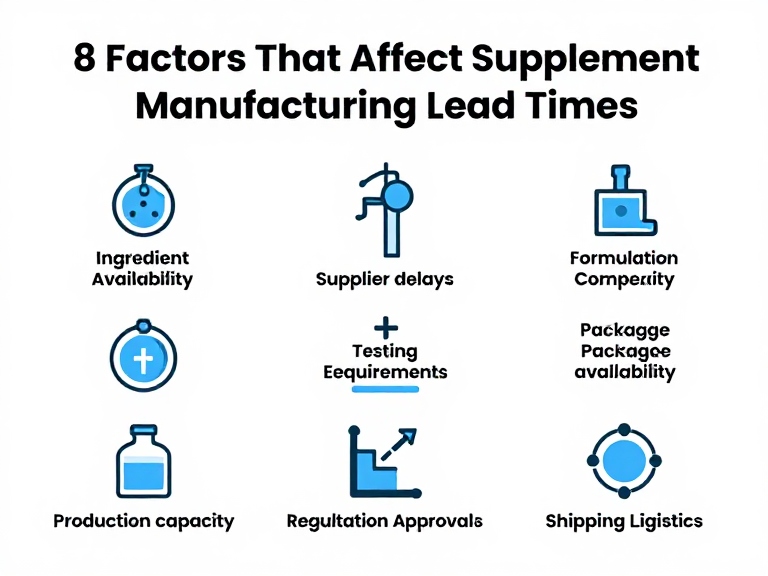
Quick Answer: What Affects Supplement Manufacturing Lead Times?
The eight main factors that affect supplement manufacturing lead times are ingredient availability, formula complexity, product format, order quantity, packaging and label readiness, testing and quality control, production capacity, and shipping or logistics. Custom formulas, imported or specialized ingredients, unusual packaging, first-time product development, and additional testing usually require more time than repeat orders using established formulas and stocked materials.
For most brands, the fastest way to shorten lead times is not to pressure the factory to manufacture faster. It is to finalize the formula and artwork early, select available ingredients and standard packaging where practical, approve samples promptly, and agree on quality and release requirements before production begins.
Quick Summary Table: Eight Factors That Affect Supplement Manufacturing Lead Times
| Factor | Why It Causes Delays | How to Reduce the Risk |
|---|---|---|
| 1. Raw material availability | Ingredients may be out of stock, imported, seasonal, or awaiting supplier documentation. | Confirm stock, supplier lead times, and acceptable alternatives before approving the order. |
| 2. Formula complexity | Custom blends, difficult-to-process ingredients, and formulation changes require more development and review. | Freeze the formula and specifications before scheduling production. |
| 3. Product format | Capsules, tablets, powders, liquids, and gummies have different processing and validation requirements. | Choose a format that fits the formula, target market, and manufacturing capability. |
| 4. Order quantity | Large runs need more materials and production time; very small runs may need special scheduling. | Match order volume to the factory’s production model and forecast demand. |
| 5. Packaging and labels | Custom bottles, closures, cartons, printed films, and artwork approvals can hold up packaging. | Approve packaging specifications and compliant artwork early. |
| 6. Testing and quality control | Raw material checks, in-process controls, finished-product testing, and documentation take time. | Agree on required tests, methods, specifications, and release criteria upfront. |
| 7. Factory capacity and scheduling | Equipment availability, changeovers, labor, and seasonal demand affect production slots. | Reserve capacity with a confirmed purchase order and complete specifications. |
| 8. Shipping and logistics | Freight, customs, export documents, and delivery appointments extend the time to market. | Plan shipping mode, destination requirements, and documentation before batch completion. |
Table of Contents
- What Is Supplement Manufacturing Lead Time?
- How the Manufacturing Timeline Works
- 8 Factors That Affect Lead Times
- Product Format Comparison
- Fast Lead Times: Pros and Cons
- Who Needs a Short Lead Time?
- When Speed Should Not Be the Priority
- How to Reduce Manufacturing Delays
- Choosing a Supplement Manufacturer
- Lead Time and Cost-Benefit Analysis
- ENZ Pharmtech Manufacturing Solutions
- Frequently Asked Questions
- References
What Is Supplement Manufacturing Lead Time?
Supplement manufacturing lead time is the period required to complete the activities between placing an order and having finished products ready for dispatch or delivery. The exact definition varies by manufacturer. Some suppliers quote only the time needed for production after all materials are available. Others include sourcing, packaging, testing, and quality release.
This difference matters. A manufacturer may quote a short production window while excluding several weeks needed to procure a custom ingredient or print a branded bottle label. If a buyer compares quotations without checking what each lead-time estimate includes, the shortest quoted schedule may not produce the earliest delivery.
For practical planning, separate the schedule into five stages:
- Product confirmation: Formula, serving size, dosage form, specifications, target market, and order quantity are finalized.
- Material procurement: Active ingredients, excipients, capsules, bottles, closures, labels, and cartons are sourced and approved.
- Manufacturing: Materials are weighed, blended, processed, filled, and packaged according to the approved production instructions.
- Quality control and release: Required tests, batch record reviews, packaging checks, and quality approvals are completed.
- Dispatch and delivery: Finished goods are packed for shipment, export documents are prepared where needed, and freight is arranged.
When asking a supplier for a lead time, ask exactly which of these stages are included. A production estimate is not the same as an order-to-delivery estimate.
How Does the Supplement Manufacturing Timeline Work?
A typical contract manufacturing project moves through a sequence of approvals and operational handoffs. The schedule is not always linear. Packaging can sometimes be prepared while ingredients are being sourced, but final production cannot proceed until the required materials and specifications are approved.
For a repeat order, the manufacturer may already have the formula, process instructions, packaging specifications, and supplier relationships in place. That can make the order easier to schedule. A first-time custom product usually involves additional work, including feasibility review, sample development, formula adjustments, artwork checks, and sometimes stability or other product-specific evaluations.
One important distinction is the difference between a target production date and a confirmed release date. A production slot can be reserved, but the finished batch still needs to meet the agreed specifications and receive quality approval. Under U.S. dietary supplement current Good Manufacturing Practice requirements, manufacturers must establish and follow specifications for components, in-process production, finished products, packaging, and labels. These controls are necessary parts of the process, not optional administrative delays.
8 Factors That Affect Supplement Manufacturing Lead Times
1. Raw Material Availability and Supplier Lead Times
Ingredient sourcing is one of the most common reasons a supplement order takes longer than expected. A manufacturer may have standard materials in stock but need to order specialized botanical extracts, branded ingredients, probiotics, enzymes, amino acids, or specific vitamin forms from external suppliers.
Availability is only one part of the issue. The ingredient may arrive with incomplete documentation, require identity testing, or need additional review before it can be released for use. Imported ingredients can also be affected by supplier production schedules, freight capacity, customs clearance, and seasonal agricultural supply.
For example, a straightforward vitamin and mineral formula using commonly available ingredients may be easier to schedule than a probiotic blend with multiple strains and specific potency requirements. A formula that includes a specialty botanical extract with a narrow supplier base may be delayed even if every other ingredient is ready.
How to reduce the delay: Ask the manufacturer to confirm stock status and expected replenishment dates for every critical ingredient. Identify long-lead materials before approving the final order. If an alternative ingredient is acceptable, document the permitted source, grade, specification, and substitution approval process in advance.
Do not authorize an ingredient substitution solely to save time. A change can affect formula composition, product claims, testing, label declarations, and customer expectations. Any substitution should go through the appropriate technical and regulatory review.
2. Formula Complexity and Customization
Formula complexity directly affects development and production planning. A simple single-ingredient capsule is generally easier to manufacture than a multi-ingredient formula with several extracts, minerals, probiotics, flavor systems, or ingredients that behave differently during processing.
Some ingredients create technical challenges. Hygroscopic powders may absorb moisture. Certain botanical extracts can have strong odors or tastes. High-dose minerals may affect tablet size or compressibility. Probiotic strains may require careful handling and moisture control. A formula that looks simple on a product brief can therefore require more development work than expected.
Custom formulations also create more approval points. The brand may need to review sample batches, adjust ingredient levels, confirm serving size, and approve the final specification. Each change made after the formula has been signed off can affect sourcing, production instructions, and label artwork.
How to reduce the delay: Decide whether the product genuinely needs a fully custom formula. For a first launch, a proven base formula or a manufacturer’s established formulation may be a more efficient starting point, provided it meets the brand’s quality and market requirements. Finalize ingredient forms, amounts, overages where appropriate, serving size, and product specifications before the purchase order is scheduled.
3. Product Format: Capsules, Tablets, Powders, Liquids, or Gummies
Different supplement formats require different equipment, process controls, and packaging operations. This is why product format can materially affect manufacturing lead times.
Capsules may require blending, encapsulation, weight checks, and filling into bottles or other packaging. Tablets involve additional considerations such as compression, hardness, friability, and disintegration. Powders may need blending, sieving, flavor adjustment, and filling into tubs or sachets. Liquids can require mixing, viscosity control, filling, and container compatibility checks. Gummies add cooking, depositing, setting, drying or conditioning, and specialized packaging considerations.
For example, a brand considering a sleep product could compare a capsule format with a gummy. A capsule may offer a simpler processing route, while a gummy may provide a more consumer-friendly format but require flavor development and additional process controls. Products such as sugar-free 5mg melatonin gummies illustrate why format decisions should be made early rather than after a production slot has been requested.
How to reduce the delay: Choose the dosage form based on the target consumer, ingredient characteristics, serving size, shelf-life requirements, and available manufacturing equipment. Do not choose gummies or liquids simply because they look more marketable if the formula and launch schedule are better suited to capsules or powders.
4. Order Quantity and Production Batch Size
Order quantity affects material purchasing, equipment setup, production duration, and packaging efficiency. Large orders may require more raw materials, additional production time, and more extensive coordination. Very small orders can also take longer if they do not fit the manufacturer’s normal batch sizes or production schedule.
Some production lines have minimum practical batch sizes. A small order may need to wait until a suitable slot is available, or the manufacturer may need to arrange a dedicated run. At the other end of the scale, a large order may require multiple production batches or staggered packaging and dispatch.
This is especially relevant to startups. A smaller initial order can reduce inventory exposure, but it does not automatically guarantee a shorter lead time or lower unit cost. A no-minimum-order arrangement may offer flexibility, yet the buyer should still confirm production scheduling, setup charges, packaging availability, and the actual time required to complete the order.
How to reduce the delay: Share realistic sales forecasts and target launch dates. Ask the manufacturer which batch sizes are most efficient for the selected product format. If the product is new, consider a commercially sensible first run that balances inventory risk with production efficiency.
5. Packaging Materials, Label Artwork, and Customization
Packaging is a frequent source of avoidable delay because brands often treat it as the final design task. In reality, custom bottles, jars, closures, induction seals, printed films, cartons, labels, and inserts can have their own sourcing and approval timelines.
A label can also delay a project if the artwork is not finalized or contains information that needs regulatory review. Supplement labels may need to address ingredient declarations, serving information, warnings, allergen statements, net contents, and market-specific requirements. A design revision after printing has started can result in wasted materials and a new procurement cycle.
Packaging compatibility matters too. The selected container must be appropriate for the product’s physical and chemical characteristics. Moisture-sensitive powders, oils, gummies, and probiotics may require different packaging protection. The cheapest bottle is not necessarily the best choice if it compromises product stability or creates filling problems.
How to reduce the delay: Approve the packaging format and artwork while the formula is being finalized. Use standard stock bottles and closures where suitable, especially for a first order. Confirm label dimensions, material, finish, barcode placement, and print proof before authorizing production. For brands targeting multiple markets, review language and regulatory requirements before ordering printed materials.
6. Testing, Quality Control, and Regulatory Documentation
Testing and quality control are essential parts of supplement manufacturing. They can affect lead times because ingredients and finished products may need to be sampled, examined, tested, documented, reviewed, and released before they can move to the next stage.
Depending on the product and risk profile, the quality plan may include identity testing, microbiological testing, heavy metal analysis, potency or assay testing, moisture testing, and other product-specific checks. Not every test is required for every formula, and the appropriate test plan depends on the ingredients, specifications, manufacturing process, intended market, and applicable regulations.
In the United States, 21 CFR Part 111 sets current Good Manufacturing Practice requirements for dietary supplements. It addresses specifications for components, in-process production, finished products, packaging, and labels, along with quality control and batch release responsibilities. These requirements explain why a responsible manufacturer cannot simply skip required checks to meet an aggressive delivery date.
Testing timelines also depend on the laboratory method and service availability. Some tests can be completed relatively quickly; others may require longer turnaround times or specialized laboratory capacity. If a result is out of specification or inconclusive, the manufacturer may need an investigation and documented disposition before the batch can be released.
How to reduce the delay: Agree on the quality specification and testing plan before production. Confirm which tests are performed in-house and which are sent to external laboratories. Ask for estimated turnaround times and clarify whether the quoted manufacturing lead time includes final quality release. Do not ask a supplier to bypass legitimate quality checks to make a shipment date.
7. Manufacturing Capacity, Equipment, and Production Scheduling
Even when all materials are available, the factory must have the right equipment, trained personnel, and production time. A manufacturer may operate several product lines, but not every line can produce every format. A capsule line cannot automatically replace a gummy line, and liquid filling equipment may require a different cleaning and setup process from powder filling.
Production schedules are also affected by changeovers, equipment cleaning, preventive maintenance, staff availability, and seasonal demand. Demand often rises before major retail periods, promotional campaigns, and the beginning of a new year. A supplier that can offer a short lead time during a quiet period may not be able to offer the same schedule during peak season.
For commercial users, manufacturing capacity should be evaluated before the brand commits to a large marketing campaign. A supplier needs to demonstrate that it can support both the initial order and likely repeat orders. A low initial quotation is not useful if the factory cannot scale production when demand increases.
How to reduce the delay: Reserve production capacity with a confirmed purchase order, approved formula, packaging specification, and agreed forecast. Ask whether the quoted date is a confirmed slot or only an estimate subject to material arrival. For repeat orders, discuss rolling forecasts and replenishment planning rather than waiting until inventory is nearly depleted.
8. Shipping, Customs, and Final Delivery
Manufacturing completion does not necessarily mean the product has arrived at the buyer’s warehouse. Finished supplements may still need export packing, freight booking, customs documentation, import clearance, and delivery coordination. International orders can be affected by port congestion, flight capacity, customs inspections, documentation errors, and local delivery arrangements.
Shipping mode also changes the timeline and landed cost. Air freight is usually faster but more expensive. Ocean freight can be more economical for larger shipments but takes longer and may involve additional handling and port-related delays. The right choice depends on the launch date, order volume, product value, and inventory strategy.
Some products may also have destination-specific import or documentation requirements. These should be checked before production rather than after the goods are ready to ship. A missing document or incorrect commercial detail can delay customs clearance even when the manufacturing work was completed on time.
How to reduce the delay: Confirm the delivery term, destination, shipping mode, importer responsibilities, and required documents before placing the order. Build a logistics buffer into the launch schedule. If the launch date is fixed, compare the total cost of faster freight with the commercial cost of arriving late.
Comparison Table: How Product Type Can Affect Manufacturing Lead Times
There is no universal rule that one supplement format is always faster. Formula complexity, equipment availability, packaging, and testing requirements can change the outcome. The following comparison is a planning guide, not a guaranteed production-time promise.
| Product Format | Typical Manufacturing Considerations | Potential Lead-Time Pressure | Best Fit |
|---|---|---|---|
| Capsules | Powder blending, encapsulation, weight checks, capsule sourcing, bottle filling. | Specialty ingredients, capsule shell availability, blend flow, and batch scheduling. | Brands prioritizing a familiar dosage form and relatively straightforward processing. |
| Tablets | Blending, granulation where needed, compression, coating, and quality checks. | Compression behavior, tooling, coating requirements, and formula adjustments. | Products needing compact servings and established tablet processes. |
| Powders | Blending, flavoring, sieving, filling, and moisture-protective packaging. | Flavor development, ingredient segregation, bulk density, and packaging supply. | Sports nutrition, drink mixes, and larger serving sizes. |
| Liquids | Mixing, viscosity control, filling, container compatibility, and preservation considerations. | Stability work, flavor development, filling setup, and packaging compatibility. | Brands requiring liquid delivery or consumer-friendly dosing. |
| Gummies | Cooking, depositing, setting, conditioning, finishing, and packaging. | Texture and flavor development, moisture control, process setup, and packaging. | Consumer-focused products where taste and format are central to the proposition. |
| Probiotic products | Strain sourcing, potency management, moisture control, processing, and packaging protection. | Specialized material sourcing, handling requirements, and stability considerations. | Brands with defined strain, potency, and storage specifications. |
For a brand choosing between formats, the best decision is the one that balances consumer appeal, formula suitability, manufacturing reliability, and shelf-life requirements. For example, a 60 billion probiotic capsule formula with prebiotics has different sourcing and handling considerations from a conventional vitamin capsule. A liquid product may require additional formulation and packaging checks, which is why brands should compare qualified liquid supplement manufacturers on their specific technical capabilities rather than on quoted speed alone.
Fast Supplement Manufacturing Lead Times: Pros and Cons
A short lead time can create a real competitive advantage, but speed is only valuable when the product is made correctly and released against agreed quality standards. There is a difference between an efficient process and a rushed process.
| Pros of a Shorter Lead Time | Cons and Risks to Consider | Our Recommendation |
|---|---|---|
| Products can reach the market sooner. | Unrealistic schedules may encourage rushed approvals or poor planning. | Shorten administrative and procurement delays, not essential quality controls. |
| Less time may be spent waiting for inventory. | Expedited materials or freight can increase costs. | Compare the cost of acceleration with the commercial value of an earlier launch. |
| Startups can test demand sooner. | Frequent formula or artwork changes can undermine the schedule. | Freeze the specification before production begins. |
| Retail replenishment can be more responsive. | Peak-season capacity may be difficult to secure. | Use rolling forecasts and reserve repeat-order capacity. |
| Less capital may be tied up in long production cycles. | Smaller or urgent runs may carry higher unit costs. | Optimize order size based on demand, production economics, and inventory risk. |
Professional judgment: A manufacturer promising an unusually short lead time before reviewing the formula, packaging, testing plan, and destination market is giving you a sales estimate—not a reliable production schedule.
Who Benefits Most from Predictable Supplement Manufacturing Lead Times?
Predictable lead times matter to almost every supplement brand, but they are especially important for businesses with fixed commercial commitments.
- Startups preparing a first launch: A delay can disrupt advertising, influencer campaigns, retailer onboarding, and cash-flow planning. Startups benefit from manufacturers who can explain each stage and support manageable initial quantities.
- Established brands managing repeat orders: Replenishment delays can create out-of-stock situations and lost sales. These brands should prioritize forecast planning, material availability, and reserved production capacity.
- Private label businesses: A broad product catalog requires consistent scheduling across multiple formats and formulas. Standardized specifications and packaging can reduce avoidable delays.
- Retail and eCommerce sellers: Seasonal campaigns and marketplace promotions depend on inventory arriving when expected. Logistics buffers are particularly important for imported products.
- Brands entering new markets: New market requirements can affect labels, testing, documentation, and import clearance. Regulatory review should happen before the production date is promised.
For beginners, a proven formula with standard packaging may be the most practical route to a first launch. For commercial users with an established customer base, a documented replenishment plan is usually more valuable than negotiating a few days off a single order.
When Should You Not Prioritize the Shortest Manufacturing Lead Time?
There are situations where choosing the fastest quote is the wrong decision. A brand developing a new formula, working with sensitive ingredients, or entering a regulated market should prioritize technical review and product quality over an aggressive delivery promise.
- New or complex formulations: Allow sufficient time for feasibility review, sample evaluation, and necessary testing.
- Products with specialized ingredients: Confirm ingredient identity, quality, and supply continuity before pushing for a production date.
- Products with stability concerns: Do not skip appropriate stability planning simply to accelerate a launch.
- First orders with custom packaging: Allow time for artwork approval, print proofs, and packaging compatibility checks.
- Products for a new destination market: Confirm applicable regulatory and import requirements before manufacturing and labeling.
Speed should come from good planning, reliable sourcing, clear specifications, and efficient coordination. It should never come from releasing a batch before required quality checks are complete.
How to Reduce Supplement Manufacturing Delays: A Practical Checklist
Most avoidable delays begin before the factory starts production. The following steps help brand owners keep a project moving without compromising quality.
- Finalize the product brief. Confirm product format, target customer, serving size, formula, ingredient specifications, target market, and order quantity.
- Check critical ingredient availability. Ask the manufacturer to identify long-lead materials and confirm supplier availability before the schedule is approved.
- Approve samples promptly. Set a clear review process for taste, appearance, texture, capsule size, and other relevant product characteristics.
- Freeze the formula. Avoid late ingredient or dosage changes after sourcing and production planning have begun.
- Prepare compliant artwork early. Confirm label content, dimensions, barcode, warnings, and market-specific information before printing.
- Agree on quality requirements. Document specifications, required tests, laboratory responsibilities, acceptance criteria, and release procedures.
- Reserve a realistic production slot. Obtain written confirmation of the conditions required to hold the slot, including material and artwork readiness.
- Plan delivery before production is complete. Confirm freight mode, destination, shipping documents, customs responsibilities, and inventory receiving arrangements.
- Build in a contingency buffer. Allow for laboratory turnaround, material delays, customs, and unexpected production issues rather than scheduling launch day immediately after the estimated completion date.
One practical improvement is to assign an owner and deadline to every approval. A project can lose several days simply because a label proof, formula specification, or sample is waiting for an internal decision. A shared project tracker is often more effective than repeated requests for a faster factory schedule.
How to Choose a Supplement Manufacturer That Can Meet Your Lead Time
When evaluating manufacturers, do not ask only, “How quickly can you make this product?” Ask what the quoted schedule depends on and how the supplier manages the factors that affect supplement manufacturing lead times.
1. Check Relevant Product Experience
A manufacturer may be capable of producing capsules but have limited experience with gummies, liquids, or complex probiotic products. Choose a supplier with relevant equipment and process knowledge for your actual formula and dosage form. If you are developing a sports nutrition product, for example, evaluate the supplier’s experience with powder blending, flavor systems, and filling rather than assuming all supplement factories offer equivalent capabilities.
2. Verify Quality Systems and Documentation
Ask about the manufacturer’s quality management system, applicable GMP controls, supplier qualification process, material traceability, batch records, laboratory arrangements, and finished-product release procedure. A certificate alone does not tell you how a specific product is controlled. Review the documents and processes relevant to your order.
For a broader supplier shortlist, ENZ Pharmtech has published resources covering GMP certified supplement companies and supplement manufacturers in Europe. Use supplier lists as a starting point for due diligence, not as a substitute for reviewing a manufacturer’s actual facilities, quality documentation, and product capabilities.
3. Ask for a Stage-by-Stage Lead-Time Breakdown
Request separate estimates for material procurement, sample development if applicable, production, testing, quality release, packaging, and dispatch. Ask which stages can run in parallel and which depend on prior approval. A transparent schedule is more useful than a single number without assumptions.
4. Confirm Production Capacity and Repeat-Order Support
Ask how the manufacturer handles urgent orders, seasonal demand, repeat production, and volume increases. If the product succeeds, can the supplier support a larger order without changing the formula, materials, or packaging unexpectedly? For established brands, this question is as important as the first delivery date.
5. Evaluate Communication and Project Management
A capable supplier should provide clear milestones, identify risks early, and tell you when a delay is likely. If the manufacturer cannot explain what is holding up an order, it will be difficult for your team to manage launch commitments. Good project communication is a measurable part of manufacturing service quality.
6. Compare Suppliers on Total Value, Not Speed Alone
Compare the full offer: product quality, formulation support, minimum order quantity, packaging choices, testing, documentation, lead-time reliability, and after-sales support. For brands comparing private label supplements in Europe, the most suitable partner is not necessarily the one with the lowest price or shortest advertised timeline. It is the one that can deliver the right product consistently under clearly agreed conditions.
Cost-Benefit Analysis: Is It Worth Paying More for Faster Supplement Manufacturing?
Expedited manufacturing, priority sourcing, special packaging arrangements, and air freight may shorten the time to market, but they can increase the total cost per unit. Whether the upgrade is worthwhile depends on the commercial consequences of arriving late.
For a product tied to a fixed retail launch, seasonal campaign, or major promotion, a faster schedule may protect revenue and retailer relationships. For a new product with uncertain demand, paying a substantial premium to accelerate production may create unnecessary financial pressure. A delayed launch is not ideal, but excess inventory and high landed costs can be equally damaging.
| Option | Potential Benefit | Cost or Risk | When It Makes Sense |
|---|---|---|---|
| Standard production schedule | Usually supports normal procurement and factory planning. | Requires more time and early forecasting. | Most planned launches and repeat orders. |
| Priority material sourcing | May reduce waiting time for critical ingredients or packaging. | Can involve higher material or sourcing costs. | When a specific long-lead item is the main bottleneck. |
| Standardized formula and packaging | Reduces development and procurement complexity. | Offers less customization. | Startups and brands validating market demand. |
| Expedited freight | Can reduce transit time after release. | Higher shipping cost and possible capacity constraints. | When goods are ready and delivery timing is commercially critical. |
| Higher inventory buffer | Protects against replenishment and logistics variability. | More working capital and storage exposure. | Established products with predictable sales velocity. |
Our recommendation is to spend money on the actual bottleneck. If ingredient sourcing is delaying the order, expedited freight will not solve the problem. If the product is finished but the launch date is at risk because of transit time, paying for faster shipping may be justified. Diagnose the constraint before approving an upgrade.
ENZ Pharmtech: Private Label Supplement Manufacturing Solutions
Private Label Supplements with No Minimum Order Options
ENZ Pharmtech offers private label dietary supplement manufacturing for startups, small businesses, and established nutraceutical brands. With more than 20 years of industry experience, advanced facilities, and certified production standards, the company supports tailored supplement products and flexible order requirements.
Explore ENZ Pharmtech private label supplement solutions
ENZ Pharmtech’s product scope includes vitamins and minerals, herbal supplements, sports nutrition, weight management, immune support, beauty and skin health, and specialty formulas. This range allows brands to consider different product categories through a private label manufacturing partner rather than coordinating every product type independently.
For example, a brand planning a cognitive or energy-support range may evaluate Acetyl L-Carnitine capsules, while a wellness range may include activated charcoal capsules. These product examples also demonstrate why each formula needs its own sourcing, packaging, and quality review rather than relying on one universal lead-time estimate.
The no-minimum-order option can be relevant to startups that want to test demand without committing to a large inventory position. However, flexible order quantities do not remove the need to confirm material availability, production scheduling, packaging choices, and testing requirements. Buyers should request a project-specific timeline and clarify what is included in the quoted lead time.
When approaching ENZ Pharmtech with a new project, prepare the target product category, desired format, ingredient brief, target market, packaging preference, estimated quantity, and launch date. The more complete the brief, the easier it is to identify potential bottlenecks early and build a realistic manufacturing plan.
Expert Recommendation: How to Get a More Reliable Manufacturing Timeline
From our experience, the most reliable supplement manufacturing schedules are built before the purchase order is issued. Brands that finalize formulas early, select practical packaging, confirm ingredient availability, and respond quickly to approvals are in a much stronger position than brands that expect the factory to absorb repeated changes without affecting delivery.
For beginners, we recommend starting with a proven formula, a standard dosage form, and readily available packaging where these choices meet the product strategy. This reduces the number of variables during the first production cycle. Once demand is established, the brand can consider custom formulations, specialized packaging, or additional product formats with a better understanding of its sales forecast.
For commercial users, the priority should be supply continuity. Maintain a rolling forecast, review material availability before inventory becomes critical, and agree on a repeat-order process with the manufacturer. For heavy-duty production requirements, confirm equipment capacity, batch-size flexibility, quality release timelines, and the supplier’s ability to scale.
Our final advice: Treat supplement manufacturing lead time as a complete supply-chain schedule, not just the number of days a factory needs to run a production line. Confirm the eight factors in writing, assign responsibility for every approval, and build a realistic buffer between batch release and your market launch. A dependable delivery date is more valuable than an aggressive promise that cannot be supported by materials, production capacity, and quality documentation.
Frequently Asked Questions About Supplement Manufacturing Lead Times
1. What is the typical lead time for supplement manufacturing?
There is no single standard lead time for all supplements. Timing depends on formula complexity, ingredient availability, product format, order quantity, packaging, testing, factory capacity, and shipping. A repeat order using stocked materials and approved artwork is generally easier to schedule than a first-time custom formulation.
2. What factors affect supplement manufacturing lead times the most?
The most significant factors are often raw material availability, custom formulation work, packaging procurement, testing and quality release, and production scheduling. International shipping and customs can further extend the time between manufacturing completion and final delivery.
3. Do custom supplement formulas take longer to manufacture?
They can. Custom formulas may require ingredient sourcing, feasibility review, sample development, formula adjustments, specification approval, and additional documentation. Finalizing the formula before production scheduling helps prevent avoidable delays.
4. Which supplement format is usually faster to manufacture?
No format is always the fastest. Capsules may be relatively straightforward when the formula and materials are established, while tablets, powders, liquids, gummies, and probiotics have different processing and quality requirements. The manufacturer’s equipment, material availability, and production schedule matter as much as the format.
5. Can a small order have a longer manufacturing lead time?
Yes. A small order may need to wait for a suitable production slot or may not match the manufacturer’s normal batch size. No minimum order quantity can provide purchasing flexibility, but it does not guarantee immediate production or the shortest lead time.
6. Does GMP testing increase supplement manufacturing lead times?
Testing and quality review require time, but they are essential parts of a controlled manufacturing process. The schedule depends on the agreed specifications, test methods, laboratory capacity, and quality release procedure. Required checks should not be skipped to meet a target date.
7. How can I reduce delays when ordering private label supplements?
Finalize the formula, confirm ingredient availability, choose suitable packaging, approve artwork early, agree on testing requirements, and reserve production capacity with a complete purchase order. Responding quickly to sample and document approvals also helps keep the project on schedule.
8. Does the quoted manufacturing lead time include shipping?
Not always. Some manufacturers quote only production time, while others include testing, release, or dispatch preparation. Ask whether the estimate ends at batch completion, quality release, warehouse dispatch, or delivery to your destination.
9. Is it worth paying extra for faster supplement manufacturing?
It depends on the commercial impact of a delay. Priority sourcing or expedited freight may be worthwhile for a fixed launch or urgent replenishment, but unnecessary acceleration can increase costs. Identify the actual bottleneck before paying for an expedited option.
10. What should I ask a supplement manufacturer before placing an order?
Ask for a stage-by-stage lead-time breakdown, material availability, formula and packaging approval requirements, production slot confirmation, testing plan, quality release process, shipping estimate, and contingency arrangements. Also confirm which events can change the agreed schedule.
References
- U.S. Food and Drug Administration (FDA) – Small Entity Compliance Guide: Current Good Manufacturing Practice in Manufacturing, Packaging, Labeling, or Holding Operations for Dietary Supplements. Guidance on dietary supplement CGMP requirements, specifications, testing, and quality control.
- Electronic Code of Federal Regulations – 21 CFR Part 111: Current Good Manufacturing Practice in Manufacturing, Packaging, Labeling, or Holding Operations for Dietary Supplements. U.S. regulatory requirements covering component controls, production specifications, packaging, labels, and finished batch quality.
- United States Pharmacopeia (USP) – Dietary Supplements. Quality resources and standards supporting the identity, strength, quality, and purity of dietary supplement ingredients and products.