
Choosing a supplement manufacturer is not simply a matter of finding a factory with an attractive price list. Your manufacturing partner will influence product safety, formula consistency, regulatory readiness, delivery reliability, and the margin you can realistically earn. A low quotation can become an expensive mistake if the supplier cannot document its quality controls or reproduce the same formula from batch to batch.
For brand owners, distributors, and new supplement businesses, the right decision is to compare manufacturers against the requirements of the product and the market—not against price alone. The nine factors below provide a practical framework for assessing suppliers before you commit to a production order.
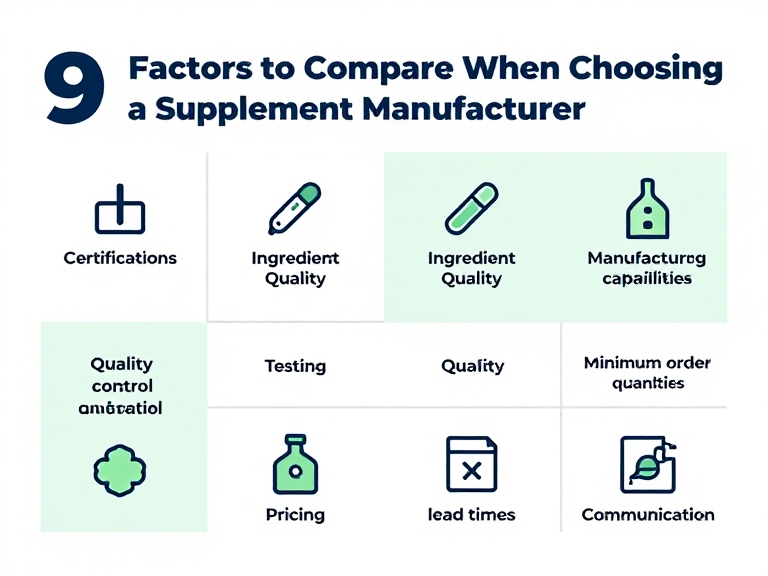
Quick Answer: What Should You Compare?
When choosing a supplement manufacturer, prioritize documented quality systems, regulatory capability, ingredient traceability, formulation expertise, testing, production capacity, packaging options, communication, and total cost. Ask for evidence rather than relying on sales claims. A suitable manufacturer should be able to explain how it controls raw materials, production processes, finished-product testing, batch records, and changes to your formula.
Our recommendation: Shortlist manufacturers that can demonstrate product-specific experience and provide a clear quality and documentation package. Compare the complete cost of delivering a compliant, saleable product—not just the quoted price per bottle or kilogram.
Table of Contents
- Quality systems and certifications
- Regulatory knowledge and market access
- Ingredient sourcing and traceability
- Formulation and product development
- Testing and quality control
- Manufacturing capability and capacity
- Packaging and customization
- Communication and supply reliability
- Pricing and total cost
- Manufacturer comparison table
- Common mistakes
- Expert recommendation
- Frequently asked questions
What Is a Supplement Manufacturer and How Does It Work?
A supplement manufacturer produces dietary supplements or nutraceutical products for brands, retailers, distributors, and other businesses. Depending on its business model, the manufacturer may provide raw material procurement, formulation, blending, encapsulation, tablet compression, powder filling, liquid filling, packaging, labeling, and finished-product testing.
There are several common service models:
- Contract manufacturing: The brand provides a formula or product specification, and the manufacturer produces it under agreed conditions.
- Private label manufacturing: The manufacturer offers existing formulas that can be sold under the customer’s brand, subject to permitted customization and labeling requirements.
- Custom formulation: The manufacturer develops or adjusts a formula based on the brand’s ingredient, dosage, format, and target-market requirements.
- Turnkey manufacturing: The supplier coordinates multiple stages, potentially including formulation, production, packaging, and documentation.
The distinction matters. A factory that is excellent at producing standard vitamin tablets may not be the best choice for a complex probiotic blend, flavored protein powder, or liquid herbal supplement. Match the service model to your actual product development needs.
Quick Summary Table: The 9 Factors at a Glance
| Factor | What to Verify | Why It Matters | Priority |
|---|---|---|---|
| 1. Quality systems | Relevant certifications, SOPs, batch records, audit evidence | Reduces quality and process-control risks | Essential |
| 2. Regulatory knowledge | Target-market requirements, ingredient and label review | Helps prevent avoidable market-access problems | Essential |
| 3. Ingredient sourcing | Supplier qualification, specifications, traceability | Supports identity, consistency, and supply continuity | Essential |
| 4. Formulation expertise | Relevant product experience, stability and compatibility work | Improves manufacturability and product performance | High |
| 5. Testing | Risk-based testing plan, COAs, laboratory controls | Verifies product quality and specification compliance | Essential |
| 6. Production capability | Equipment, process controls, capacity, batch size | Determines whether the supplier can deliver consistently | High |
| 7. Packaging | Format options, compatibility, labeling, protection | Affects stability, usability, and brand presentation | Medium–High |
| 8. Communication | Project ownership, response times, change control | Prevents delays and misunderstandings | High |
| 9. Total cost | Setup, testing, packaging, freight, rework, MOQ | Reveals the true commercial cost | High |
1. Quality Systems and Certifications
Quality management should be the first filter when choosing a supplement manufacturer. A polished factory presentation or a list of certification logos is not enough. You need to understand which systems are implemented, which production site they cover, what product categories they apply to, and whether the supplier can show how those systems work in practice.
Depending on the country, product category, and intended market, relevant frameworks may include Good Manufacturing Practices (GMP), food safety management systems, and quality management standards. In the United States, dietary supplement manufacturers are subject to the applicable requirements in 21 CFR Part 111. Other markets have their own regulatory and manufacturing requirements. A certificate should never be treated as a substitute for understanding the actual legal obligations.
What to Ask the Manufacturer
- Which certifications and manufacturing licenses apply to the specific production facility?
- Can you provide current certificates and clarify their scope and validity?
- Are production procedures, cleaning records, batch records, and deviation procedures documented?
- How are nonconforming materials and finished products identified and controlled?
- Can customers arrange a facility audit or review relevant quality documentation?
From our experience, the strongest suppliers explain their quality process clearly and consistently. They should be able to describe how a raw material lot is received, inspected, approved, stored, used in production, and linked to the finished batch.
Practical decision: Do not proceed with a manufacturer that refuses to clarify the scope of its certifications or cannot explain its batch-control procedures. A low unit price does not compensate for an unclear quality system.
2. Regulatory Knowledge and Target-Market Experience
A supplement that can be manufactured is not automatically suitable for sale in every country. Ingredient permissions, maximum levels, product classification, labeling rules, claims, notification requirements, and import controls can vary significantly between markets.
For example, a product intended for the United States may need to be assessed against FDA dietary supplement requirements, while products sold in the European Union must be considered within the relevant EU food supplement and food-law framework, including applicable national requirements. Australia, Canada, and other markets have their own systems and product classifications.
The manufacturer’s regulatory experience should match your destination market and formula. A supplier familiar with ordinary multivitamins may have limited experience with botanicals, probiotics, sports nutrition, or products containing novel or restricted ingredients.
Check These Regulatory Capabilities
- Ingredient and dosage review against your target-market requirements.
- Support for product specifications, ingredient statements, and technical documentation.
- Label review support for mandatory information and permitted claims.
- Experience with export documentation and the requirements of your destination market.
- A clear explanation of which regulatory tasks are performed by the manufacturer and which remain your responsibility.
Do not assume that a manufacturer offering label design also provides legal approval. Health claims and product classification may require independent regulatory advice. The brand owner should retain responsibility for confirming that the finished product can legally be marketed in its intended jurisdiction.
If you are comparing overseas suppliers, it can help to review market-specific options such as nutraceutical manufacturers in the USA, supplement manufacturers in Europe, and dietary supplement manufacturers in Canada. Treat directories as starting points for due diligence, not as proof that a supplier is suitable.
3. Ingredient Sourcing, Supplier Qualification, and Traceability
Finished-product quality starts with raw materials. Even a well-designed formula can produce inconsistent results if ingredient identity, potency, purity, or storage conditions are not controlled. This is especially important for botanical extracts, probiotics, enzymes, specialty amino acids, and ingredients with meaningful variation between suppliers or harvests.
A capable manufacturer should have a documented supplier qualification process. It should know where ingredients come from, what specifications they must meet, how incoming materials are checked, and how each lot is traced through production.
Documents Worth Requesting
- Raw material specification sheets and certificates of analysis (COAs).
- Identity verification records appropriate to the ingredient and risk profile.
- Microbiological, heavy metal, pesticide, residual solvent, or other relevant test results.
- Supplier approval and periodic review procedures.
- Traceability records connecting raw material lots to finished-product batches.
A COA is useful, but it is not automatically conclusive. Ask whether the results are generated by the ingredient supplier, the manufacturer, or an independent laboratory. Also ask which tests are performed on every lot and which are conducted periodically based on risk. The answer should make sense for the ingredient and product.
For commercial users, ingredient continuity matters as much as initial quality. If a key botanical extract or branded ingredient becomes unavailable, can the manufacturer identify an approved alternative? Will the change trigger a formula review, new testing, label changes, or stability assessment? These questions should be resolved before launch, not during a supply interruption.
4. Formulation Expertise and Product Development
Formulation capability separates a production-only supplier from a partner that can help solve product development problems. A manufacturer may be able to blend a formula you provide, but that does not mean it can develop a stable, scalable, pleasant-to-use product.
Different formats create different technical challenges. A powder blend may separate during handling or have poor flow. A tablet may have compression or disintegration issues. A capsule formula may exceed practical fill capacity. A liquid supplement may require careful attention to solubility, preservation, pH, and packaging compatibility.
Questions That Reveal Real Expertise
- Have you manufactured products with similar ingredients and dosage formats?
- Can you assess ingredient compatibility and manufacturing feasibility?
- Do you offer prototype samples or pilot batches?
- How do you evaluate taste, odor, flowability, disintegration, or other product-specific attributes?
- What stability work is recommended before commercial launch?
In most professional situations, we recommend a pilot batch when the formula is new, technically demanding, or commercially important. A sample can reveal problems with flavor, texture, capsule size, powder flow, or packaging that are difficult to predict from a formula sheet alone.
Choose a supplier with experience in your product category. For example, a sports nutrition brand may need expertise in protein powders, creatine, amino acids, or pre-workout blends. A wellness brand may need a different capability for herbal extracts, vitamins, minerals, probiotics, or liquid formulations. You can compare category-specific supplier options such as protein powder manufacturers in Australia and private label pre-workout manufacturers.
5. Testing, Quality Control, and Batch Consistency
Testing is not a box to tick at the end of production. It is part of the control strategy that helps verify raw material identity, manufacturing consistency, and finished-product compliance with agreed specifications.
The appropriate testing plan depends on the formula, ingredients, dosage form, risks, and destination market. Common categories may include identity, potency or assay, microbiological quality, heavy metals, moisture, disintegration, dissolution, or other product-specific tests. Not every test applies to every supplement, and not every test needs to be repeated at the same frequency. The manufacturer should be able to justify its approach.
Do Not Accept a Generic Testing Promise
Ask for a written testing matrix that identifies the material or product being tested, the test method or specification, the frequency, and the party responsible. If an outside laboratory is used, ask whether it is appropriately accredited for the relevant testing scope. A laboratory accreditation logo alone does not establish that every method or analyte is covered by its accreditation.
Also ask how the manufacturer handles out-of-specification results. A reliable process should include investigation, documented disposition, and appropriate corrective action. The supplier should not simply repeat a test until a passing result appears without investigating the original failure.
For a new brand, batch consistency is particularly important. Your first production run may look acceptable, but customers will judge the product based on every reorder. Ask how the manufacturer controls blend uniformity, fill weights, tablet or capsule variation, and other relevant critical quality attributes.
Expert insight: A finished-product COA is useful only when it relates to the actual batch supplied and reports results against clear specifications. Request a sample COA before placing an order so you can assess the level of detail.
6. Manufacturing Equipment, Production Capacity, and Scalability
The right manufacturer must be able to produce your product reliably at your current volume and at the volume you expect to reach. A supplier may be suitable for a small launch but struggle when orders increase. Another may have impressive production capacity but be unwilling to accommodate smaller commercial runs.
Evaluate the equipment and process capability required for your dosage form. Capsules, tablets, powders, gummies, softgels, and liquids require different machinery, process controls, and technical experience. Do not assume that a company offering one format can manufacture all formats to the same standard.
Evaluate Capacity Beyond the Factory’s Headline Output
- What is the practical minimum and maximum batch size for your product?
- Can the manufacturer reserve production capacity for repeat orders?
- What is the normal lead time for raw materials, production, testing, and packaging?
- How are production schedules affected by seasonal demand or equipment maintenance?
- Can the supplier scale volume without changing the process in ways that affect quality?
For beginners, a manageable first run can reduce inventory risk. For established brands, the priority may be reliable repeat capacity and predictable lead times. For commercial users with seasonal campaigns, production planning and contingency capacity can be more valuable than a small discount on unit price.
If your business is still validating demand, consider a supplier that can discuss smaller production quantities. ENZ Pharmtech offers private label supplement options with no minimum order solutions for eligible projects. Confirm the specific product, packaging, customization, and commercial conditions directly before treating a low or zero MOQ as available for every formula.
7. Packaging, Labeling, and Customization Options
Packaging influences product protection, shelf presentation, shipping cost, customer experience, and sometimes the product’s stability. The best format depends on the formulation and the target customer—not simply on what looks attractive in a product mockup.
Common options include bottles, jars, sachets, pouches, tubs, blister packs, and liquid containers. Each has different implications for moisture protection, oxygen exposure, light sensitivity, portion control, transport, and filling efficiency.
What to Compare
- Material compatibility: Is the packaging suitable for the formula and expected storage conditions?
- Barrier properties: Does it provide appropriate protection against moisture, oxygen, and light where needed?
- Closure and tamper evidence: Are seals, caps, liners, and tamper-evident features appropriate?
- Labeling: Can the supplier apply your approved artwork and provide accurate production proofs?
- Customization: Are there choices for container size, color, finish, scoop, insert, or secondary packaging?
Before approving packaging, request a physical sample or prototype. Check the container dimensions, closure, label placement, readability, and shipping suitability. For powders, also consider scoop size, powder settling, and whether the package can be resealed cleanly.
Do not approve artwork until the ingredient declaration, serving information, warnings, claims, and other required label elements have been reviewed for the destination market. A manufacturer can support production and artwork preparation, but the brand should verify final legal compliance.
8. Communication, Project Management, and Supply Reliability
Manufacturing projects involve many decisions: formula approval, ingredient procurement, sample feedback, artwork, packaging specifications, production scheduling, testing, and shipment. If the supplier communicates poorly, even a technically capable factory can become difficult to work with.
During the quotation stage, pay attention to how the manufacturer handles detailed questions. Does it respond with specific information, or does it repeatedly promise that everything is possible? Does it identify missing information before quoting? Does it explain which steps require your approval?
Look for a Defined Project Process
- A named contact responsible for coordinating your order.
- A written quotation with specifications, assumptions, exclusions, and validity period.
- Milestones for sampling, formula approval, artwork approval, production, testing, and dispatch.
- A documented process for approving formula, ingredient, packaging, or supplier changes.
- Clear escalation procedures for delays, quality issues, and shipment problems.
Ask how you will be informed if a raw material is delayed or a production issue occurs. A dependable partner raises problems early and proposes options. A supplier that only communicates when you chase it creates unnecessary risk for your launch schedule.
For businesses selling across borders, also clarify export documents, shipping responsibilities, delivery terms, and who handles any required product-specific documentation. Do not assume that the factory’s export experience removes the brand’s own import or market-compliance obligations.
9. Pricing, Minimum Order Quantity, and Total Cost of Ownership
Price matters, but comparing quotations by unit cost alone is one of the most common procurement mistakes. Two manufacturers may quote different prices because their offers include different ingredients, packaging, testing, setup work, or service levels.
A realistic cost comparison should include all costs required to receive a finished product that can be sold. Depending on the project, these may include:
- Formula development, sample preparation, and setup charges.
- Raw materials, including premium or branded ingredients.
- Manufacturing, filling, encapsulation, compression, or blending.
- Packaging components, labels, cartons, and printing setup.
- Testing, documentation, and any required third-party laboratory work.
- Freight, insurance, customs, duties, and local handling.
- Storage, shelf-life management, and the cost of unsold inventory.
Understand the Commercial Impact of MOQ
Minimum order quantity affects cash flow and inventory exposure. A large order may reduce the quoted unit price, but it can tie up capital and increase the risk of holding slow-moving stock. A smaller order may cost more per unit while allowing you to test demand, improve the formula, or refine the packaging before scaling.
For startups, lower MOQ can be commercially sensible if the supplier can maintain the same quality controls and provide suitable packaging. For established brands with stable demand, larger production runs may improve purchasing efficiency. The right choice depends on forecast accuracy, shelf life, storage capacity, and sales velocity.
For a broader view of the commercial options, review private label supplements with no minimum order and compare the conditions carefully. A low MOQ does not automatically mean low total cost; customization, packaging, testing, and shipping can still create fixed expenses.
Supplement Manufacturer Comparison: What Different Supplier Types Offer
Not every supplier provides the same level of service. The following comparison can help you decide which manufacturing model is appropriate for your business.
| Supplier Type | Typical Service | Advantages | Limitations | Best For |
|---|---|---|---|---|
| Private label manufacturer | Existing formulas with brand customization | Potentially faster launch and simpler development | Formula differentiation may be limited | Startups and brands testing demand |
| Custom contract manufacturer | Production based on customer formula or specifications | Greater control over formulation and product identity | Development and validation may take longer | Established brands and differentiated products |
| Full-service or turnkey partner | May coordinate formulation, production, packaging, and documentation | Fewer supplier handoffs and simpler project coordination | Service scope and fees require careful review | Brands seeking an integrated supply partner |
| Production-focused factory | Manufacturing against defined specifications | Can be efficient for repeat, standardized orders | May offer limited formulation or regulatory support | Buyers with established formulas and technical teams |
Our view is straightforward: choose the simplest supplier model that still covers your real technical and compliance needs. Paying for a turnkey service makes sense when you need the coordination. It is unnecessary if you already have a validated formula, approved packaging, and an experienced regulatory team.
Pros and Cons of Working with a Private Label Supplement Manufacturer
| Pros | Cons and Risks to Manage |
|---|---|
| Can shorten the route from product selection to launch. | Existing formulas may be similar to products sold by other brands. |
| May reduce the need to build in-house production facilities. | Your business depends on the manufacturer’s capacity and service quality. |
| Can provide access to established production processes and packaging options. | Customization may be limited by equipment, formula ownership, or MOQ. |
| Lower-volume options can help reduce initial inventory exposure. | Small runs may have higher per-unit costs or additional setup fees. |
| Experienced suppliers may support documentation and quality processes. | The brand still needs to verify market compliance and its own legal responsibilities. |
Best Use Cases: Which Manufacturer Is Right for Your Business?
For Startups and First-Time Supplement Brands
Prioritize a manufacturer that can explain the process, offer suitable existing formulas, and discuss manageable production quantities. Avoid investing heavily in custom packaging or a complex formula before you have validated demand. Request samples, understand all setup fees, and establish the documentation you will receive with the order.
For Established Supplement Brands
Focus on repeatability, ingredient continuity, production planning, and change control. A supplier that performs well on one order must also be able to reproduce the product over time. Review historical batch documentation where available and agree on how specifications and approved suppliers will be maintained.
For Sports Nutrition and Protein Brands
Assess powder handling, flavor development, blend uniformity, packaging performance, and the supplier’s experience with protein and performance ingredients. A supplier with relevant experience in custom protein powder manufacturing may be more appropriate than a general capsule-focused factory.
For Brands Selling in Multiple Countries
Regulatory support and documentation become more important when the same product is sold in multiple jurisdictions. Do not assume that one label, ingredient list, or set of claims will be acceptable everywhere. Build market-specific review into the launch plan and confirm which party is responsible for each regulatory task.
Common Mistakes When Choosing a Supplement Manufacturer
- Choosing the cheapest quotation. A low price may exclude testing, packaging, documentation, or other necessary services. Compare like-for-like specifications.
- Accepting certification claims without checking scope. Verify the facility, product category, validity, and applicable standard rather than relying on a logo in a brochure.
- Ignoring ingredient traceability. Ask how raw materials are qualified and connected to finished batches.
- Skipping samples or pilot production. A formula that looks good on paper may not perform well in the intended dosage form.
- Assuming the manufacturer handles all compliance. Agree on responsibilities and obtain appropriate regulatory review for your destination market.
- Over-ordering to secure a lower unit price. Consider demand uncertainty, shelf life, cash flow, and storage before committing to a large MOQ.
- Failing to document specifications. Formula, packaging, testing, and acceptance criteria should be agreed in writing before production.
- Not planning for repeat orders. Ask about lead times, ingredient availability, and how changes will be communicated.
Cost-Benefit Analysis: Is a Higher-Priced Manufacturer Worth It?
A more expensive manufacturer can be the better commercial choice when the additional cost buys meaningful improvements in quality assurance, technical support, documentation, or supply reliability. However, a premium quotation is not proof of superior performance. You need to identify exactly what the price difference covers.
Consider two hypothetical quotations for the same supplement. Supplier A offers a lower price but excludes independent testing and provides limited documentation. Supplier B charges more but includes a defined testing package, traceability records, and a named project manager. Supplier B may offer better value if those services reduce your compliance workload, prevent avoidable delays, or help you manage quality risk. The decision should be based on the actual scope and evidence—not on the assumption that higher prices always mean higher quality.
Calculate the expected landed cost per saleable unit, including rejected units, packaging, freight, and inventory holding costs. Then assess the commercial consequences of a delayed launch or inconsistent reorder. These costs are often overlooked in the initial comparison.
ENZ Pharmtech: Private Label Options for Different Supplement Categories
For brands that want to launch without immediately developing a fully bespoke formula, ENZ Pharmtech provides private label dietary supplement manufacturing solutions across several product categories. Its stated service proposition includes no-minimum-order options for eligible projects, which can be relevant to startups, small businesses, and established brands testing new product lines.
Available product categories include vitamins and minerals, herbal supplements, sports nutrition, weight management, immune support, beauty and skin health, and specialty formulas. Examples include multivitamins, vitamin C, vitamin D, calcium, magnesium, ginseng, turmeric, protein powders, pre-workout products, amino acids, creatine, collagen, probiotics, and digestive enzymes.
With more than 20 years of experience stated by the company, ENZ Pharmtech positions itself as a private label supplement manufacturing partner for businesses seeking tailored products and production support. As with any manufacturer, buyers should confirm the exact facility, certification scope, formula options, testing plan, packaging, lead time, and order conditions for their specific project before proceeding.
Private Label Supplements with No Minimum Order
ENZ Pharmtech offers private label supplement solutions intended to support startups, small businesses, and established nutraceutical brands. The service covers a range of supplement categories, with product-specific customization and production conditions to be confirmed during quotation.
Explore private label supplement manufacturing options
Expert Recommendation: How to Make the Final Decision
Do not select a supplement manufacturer based on a single sales call, a low MOQ, or a list of product categories. Use a structured evaluation and require evidence at each stage. A manufacturer that is transparent about its capabilities—and equally transparent about its limitations—is generally easier to assess than one that promises every service without explaining the details.
We recommend the following process:
- Write a product brief. Define the dosage form, target market, formula or ingredient concept, packaging, expected volume, and launch schedule.
- Shortlist relevant manufacturers. Focus on suppliers with experience in your product format and intended market.
- Request comparable quotations. Use the same formula, packaging, testing, and delivery assumptions for each supplier.
- Review quality documentation. Check certification scope, raw material controls, traceability, testing, and batch records.
- Evaluate a sample or pilot batch. Assess product characteristics and confirm that the manufacturing process is suitable.
- Agree on specifications and responsibilities. Document formula ownership, approved suppliers, testing, packaging, change control, and acceptance criteria.
- Start with a commercially sensible order. Balance unit economics against inventory exposure and the need to validate demand.
For beginners, a supplier with a straightforward private label process and manageable order conditions may be the most practical starting point. For commercial users, prioritize proven batch consistency, documented quality controls, and reliable capacity. For complex or differentiated formulas, choose a partner with the technical resources to support formulation and scale-up.
The best manufacturer is not necessarily the largest, cheapest, or most heavily promoted. It is the one that can make your specific product to an agreed specification, document the work, support your target-market requirements, and deliver consistently as your business grows.
Frequently Asked Questions About Choosing a Supplement Manufacturer
1. What is the most important factor when choosing a supplement manufacturer?
Quality systems and the ability to demonstrate consistent process control should be the first priority. Review the manufacturer’s applicable certifications, raw material controls, batch records, testing procedures, and traceability. Then assess regulatory capability and product-specific manufacturing experience.
2. How do I verify whether a supplement manufacturer is reliable?
Request current facility-specific certificates, quality documentation, sample COAs, raw material specifications, and details of its testing and deviation procedures. Ask whether a facility audit or quality review is possible. Check references where available and assess how clearly the supplier answers technical questions.
3. What is the difference between private label and contract supplement manufacturing?
Private label manufacturing commonly uses existing formulas that a brand can market under its own name, sometimes with limited customization. Contract manufacturing generally produces supplements to customer-provided specifications or agreed custom formulas. The exact service scope varies by supplier, so confirm formula ownership, development responsibilities, and customization rights.
4. What documents should I request before placing a supplement order?
Depending on the project, request facility certifications, product and raw material specifications, ingredient COAs, a proposed finished-product testing plan, sample finished-product COAs, manufacturing and packaging specifications, and relevant regulatory documentation. Also obtain a written quotation and production agreement that define responsibilities and acceptance criteria.
5. Is a supplement manufacturer with no minimum order quantity a good choice?
It can be useful for startups and brands testing demand because it may reduce initial inventory commitments. However, confirm which products qualify, whether the formula is standard or custom, and whether packaging, testing, setup, and freight create additional costs. A low MOQ is valuable only when quality and commercial conditions remain suitable.
6. How much does supplement manufacturing cost?
Costs depend on formula complexity, ingredient quality, dosage form, order quantity, packaging, testing, customization, and shipping. Request an itemized quotation and calculate the total landed cost per saleable unit. Avoid comparing suppliers using unit price alone when their service scopes differ.
7. Should I choose a local or overseas supplement manufacturer?
Neither option is automatically better. Local manufacturing may simplify communication, visits, and logistics, while overseas suppliers may offer different capabilities, pricing, or ingredient access. Compare regulatory requirements, documentation, quality controls, lead times, shipping costs, and the supplier’s experience with your destination market.
8. Can a supplement manufacturer help develop a custom formula?
Many manufacturers offer formulation support, but the level of service varies. Ask about ingredient compatibility, dosage feasibility, flavor development, pilot batches, stability work, and formula ownership. For complex products, agree on development milestones and approval criteria before paying for formulation work.
9. How can I ensure consistent quality between production batches?
Establish approved product and raw material specifications, a defined testing plan, documented manufacturing controls, batch traceability, and a formal change-control process. Review batch-specific COAs and investigate deviations. Agree in writing how ingredient or process changes will be communicated and approved.
10. How many supplement manufacturers should I compare?
Start with three to five relevant suppliers. This is usually enough to compare service models, technical capabilities, quality documentation, pricing, and communication without creating an unnecessarily large evaluation process. Keep only suppliers that meet your essential quality and regulatory requirements in the final comparison.
References and Regulatory Resources
The following authoritative sources provide useful regulatory and quality-system context. Requirements should always be checked against the current rules for the product category and destination market.
- U.S. Electronic Code of Federal Regulations – 21 CFR Part 111: Current Good Manufacturing Practice in Manufacturing, Packaging, Labeling, or Holding Operations for Dietary Supplements.
- U.S. Food and Drug Administration – Dietary Supplements: regulatory information and industry guidance.
- International Organization for Standardization – ISO 22000: Food safety management systems.
Manufacturing requirements, permitted ingredients, labeling rules, and regulatory responsibilities vary by jurisdiction and product. This article is intended as a supplier-evaluation guide, not a substitute for legal, regulatory, or technical advice for a specific supplement.