
Launching or scaling a nutraceutical brand in today’s cutthroat wellness market is an exercise in engineering discipline, analytical chemistry, and commercial precision. Far too many brand owners believe that bringing a dietary supplement to market simply means blending raw herbal powders in a drum, pressing them into plastic bottles, and running digital advertisements. That superficial approach is a direct path to regulatory audits, product recalls, failed label claims, and ruined customer trust. In an era where consumer scrutiny and federal regulatory bodies enforce rigorous compliance, mastering the complete vitamin supplement manufacturing process is mandatory. From validating raw active botanical extracts down to the parts-per-billion level to ensuring your secondary retail packaging protects delicate bioactives from ambient light degradation, every single link in the supply chain dictates your commercial viability. As manufacturing practitioners who oversee formulation development, cleanroom encapsulation, and retail packaging execution, we break down the definitive six-step workflow required to take a supplement from raw chemical specification to high-performing retail reality.
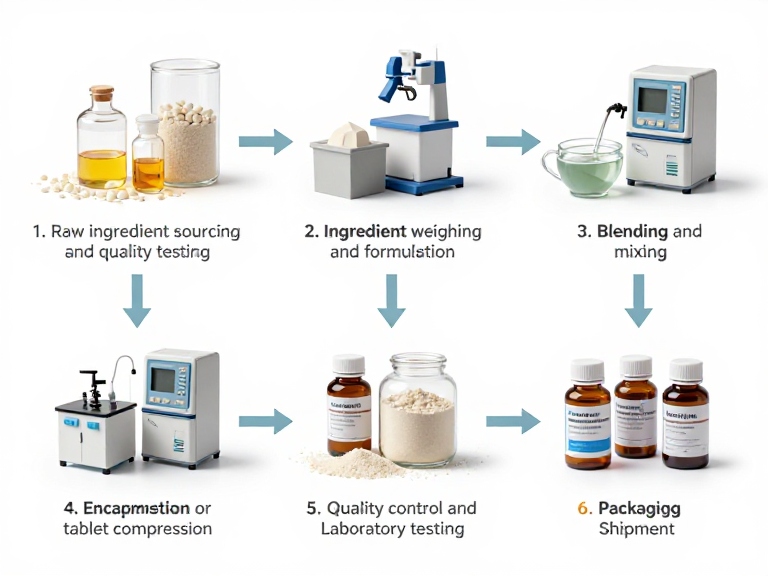
Quick Answer: The 6 Core Steps of the Vitamin Supplement Manufacturing Process
The industrial vitamin supplement manufacturing process follows six sequential, non-negotiable phases: (1) Raw Material Sourcing, Quarantine & Analytical Testing (verifying identity, assay potency, heavy metals, and microbials via HPLC and ICP-MS under FDA 21 CFR Part 111); (2) Precision Weighing, Particle Micronization & V-Blending (achieving absolute blend uniformity and preventing demixing); (3) Dosage Form Execution (high-speed rotary tableting, two-piece hard gelatin/HPMC encapsulation, or gummy depositing); (4) In-Process Quality Control (IPQC) & Functional Coating (monitoring weight variation, hardness, friability, disintegration times, and inline metal detection); (5) Primary Bottling & Induction Sealing (inserting desiccants, filling, torquing child-resistant closures, and hermetic induction sealing); and (6) Secondary Packaging, Regulatory Labeling & Brand Presentation (engineering custom rigid boxes, folding cartons, and tamper-evident outer packaging with partners like Ebifine). Skipping or rushing any of these stages compromises safety, destroys profit margins, and invites regulatory enforcement.
Article Directory
- The cGMP Foundation: What the Vitamin Supplement Manufacturing Process Involves
- Quick Summary Table: The 6 Manufacturing Steps at a Glance
- The 6 Steps of the Vitamin Supplement Manufacturing Process Detailed
- Secondary Packaging Spotlight: Ebifine Custom Packaging Solutions
- Direct Technical Comparison: Dosage Form Manufacturing Complexities
- Pros and Cons of Custom Contract Manufacturing vs. Stock Formulations
- Who Needs Custom Manufacturing vs. Who Can Rely on Stock White-Label
- Catastrophic Sourcing Mistakes Brand Owners Make in Production
- Essential Sourcing Checklist: Auditing a Contract Manufacturer (CMO)
- Expert Practitioner Verdict & Commercial Roadmap
- Frequently Asked Questions
- Authoritative References & Regulatory Standards
The cGMP Foundation: What the Vitamin Supplement Manufacturing Process Involves
To evaluate the vitamin supplement manufacturing process with commercial clarity, brand directors must look past marketing claims and understand the realities of industrial batch manufacturing. Dietary supplement production in developed markets is strictly governed by statutory frameworks, most notably the United States Food and Drug Administration’s 21 CFR Part 111 regulations. These Current Good Manufacturing Practice (cGMP) mandates require that every single commercial batch possess an unbroken audit trail known as the Master Manufacturing Record (MMR) and individual Batch Production Record (BPR).
At an engineering level, a supplement is an active chemical delivery vehicle. Whether the end product is a high-potency antioxidant like Alpha Lipoic Acid ALA Capsules 600mg, an advanced cellular metabolic booster like Alpha-Ketoglutaric Acid AKG Capsules, or a complex multi-ingredient recovery blend such as Amino Acids Capsules L-Glutamine L-Leucine L-Isoleucine L-Valine BCAA, the industrial objective remains identical: ensuring that the exact milligram weight stated on the Supplement Facts panel is consistently delivered in every single serving, from the first bottle of a 100,000-unit run to the last, without degradation, microbial contamination, or physical defect.
From our experience on production facility floors, achieving this requires orchestrating chemical engineering, cleanroom HVAC humidity management, high-speed rotary mechanics, and protective packaging materials. If ambient relative humidity rises above 35% during the processing of hygroscopic herbal powders, the active ingredients cake, machinery jams, and chemical hydrolysis begins before the batch even leaves the factory.
Quick Summary Table: The 6 Manufacturing Steps at a Glance
| Step # | Process Phase | Primary Industrial Machinery | Key Quality Control Parameter | Critical Failure Prevented |
|---|---|---|---|---|
| Step 1 | Raw Material Sourcing & Quarantine | FTIR, HPLC, ICP-MS, Autoclaves | 100% Identity, Potency & Heavy Metals test | Counterfeit ingredients and toxic lead/cadmium contamination |
| Step 2 | Weighing, Milling & Blending | Conical Mills, Ribbon / V-Blenders | Relative Standard Deviation (RSD < 5%) | Hot spots, uneven dosage, and micro-nutrient segregation |
| Step 3 | Dosage Form Execution | Rotary Tablet Presses, High-Speed Encapsulators | Fill weight uniformity, compression tonnage | Cracked tablet caps, dented shells, and dose variation |
| Step 4 | IPQC, Polishing & Coating | Perforated Coating Pans, Metal Detectors | Friability (<1%), Disintegration (<30 mins) | Gastrointestinal irritation and tablet crumbling in transit |
| Step 5 | Primary Bottling & Induction Sealing | Rotary Slat Counters, Induction Sealers | Seal hermeticity, vacuum retention, desiccant placement | Moisture ingress, oxidation, and active nutrient degradation |
| Step 6 | Secondary Packaging & Presentation | Automated Cartoners, UV Coating & Rigid Box Rig | REACH compliance, structural drop tests, retail branding | Crushed retail boxes, faded graphics, and consumer distrust |
The 6 Steps of the Vitamin Supplement Manufacturing Process Detailed
Step 1: Raw Material Sourcing, Quarantine & Analytical Testing
Every commercial production run starts at the loading dock, and this is where quality either succeeds or fails. Under cGMP guidelines, raw botanical powders, mineral salts, synthetic vitamins, and excipients cannot be moved directly into blending rooms. Upon arrival, every lot is assigned an internal tracking number and placed into a physical Quarantine Holding Zone.
Quality Control chemists pull representative samples based on ANSI/ASQ Z1.4 statistical sampling plans. The materials undergo four strict testing batteries:
- Identity Testing: Fourier Transform Infrared Spectroscopy (FTIR) or High-Performance Thin-Layer Chromatography (HPTLC) compares the raw material’s molecular fingerprint against certified reference standards.
- Assay Potency: High-Performance Liquid Chromatography (HPLC) verifies that an active extract—such as high-purity Apigenin Capsules 100mg or a delicate sleep aid formulation like Apigenin Theanine Capsules Sleep & Relaxafion—contains the exact concentration of target flavonoids claimed on the raw Certificate of Analysis (CoA).
- Heavy Metal Contamination: Inductively Coupled Plasma Mass Spectrometry (ICP-MS) tests for toxic elements: lead, arsenic, cadmium, and mercury, ensuring compliance with strict California Proposition 65 limits.
- Microbiological Screening: Incubation for total aerobic microbial count (TAMC), yeast, mold, and pathogens including E. coli, Salmonella, and Staphylococcus aureus.
Only when the laboratory releases a signed Certificate of Analysis is the raw material cleared to enter the manufacturing floor.
Step 2: Precision Weighing, Particle Micronization & V-Blending
Once cleared, technicians transfer the raw materials into cleanroom dispensary suites operating under negative air pressure to prevent cross-contamination. Every active ingredient and functional excipient (such as microcrystalline cellulose, magnesium stearate, and silica) is measured on calibrated, analytical scales linked directly to the Batch Production Record.
In most professional situations, raw botanical powders exhibit wide variations in particle size and morphology. If you attempt to blend a coarse herbal powder with a micronized synthetic vitamin, the mixture will segregate inside the blending drum. To solve this, materials pass through oscillating granulators or conical mills to standardize particle size (typically 60 to 80 mesh). The powders then enter industrial V-blenders or double-cone blenders. Blending duration and rotational speed are strictly validated: under-blending leaves dangerous hot spots of concentrated active ingredients, while over-blending generates frictional heat that degrades heat-sensitive vitamins and creates electrostatic charges that cause powders to cling to equipment walls.
Step 3: Dosage Form Execution (Encapsulation, Tableting, or Gummy Extrusion)
With a homogeneous blend secured, the batch moves to dosage form execution. The choice of delivery format dictates the machinery and excipient profile required:
- Hard Shell Encapsulation: Automated tamping-pin or dosator encapsulators run at speeds up to 150,000 capsules per hour. Empty two-piece hard gelatin or vegetarian hydroxypropyl methylcellulose (HPMC) capsule bodies are separated, filled with a precise powder slug, joined, and locked. This format is ideal for bitter botanicals or hygroscopic powders like Apple Cider Vinegar ACV Capsules 1300mg.
- Rotary Tablet Compression: Granulated powders are fed into high-tonnage rotary tablet presses. Upper and lower hardened steel punches compress the powder into dense, uniform tablets under several metric tons of pressure per square inch. Compression force must be calibrated to ensure tablets are hard enough to withstand transport while remaining porous enough to dissolve readily in stomach acid.
- Gummy Extrusion & Depositing: Active vitamins are mixed into a hot pectin or gelatin syrup base, homogenized, and deposited into Teflon molds. After passing through cooling tunnels, gummies are demolded, dried in humidity-controlled rooms, and lightly tumbled in organic carnauba wax to prevent sticking, as seen in popular formats like Apple Cider Vinegar Gummy 1000mg.
Step 4: In-Process Quality Control (IPQC), Polishing & Film Coating
Manufacturing does not pause for end-of-batch testing; quality control happens continuously on the factory floor. Every 15 to 30 minutes, cleanroom technicians pull samples directly from the running presses to perform five standardized tests:
- Individual & Average Weight Variation: Ensuring capsule fill or tablet mass stays within plus-or-minus 2% to 3% of target specifications.
- Tablet Hardness & Thickness: Measured via automated electronic jaw testers to ensure structural durability.
- Friability Testing: Tumbling tablets in a rotating drum under USP <1216> guidelines; acceptable batches must lose less than 1.0% of their mass to dust.
- Disintegration Testing: Immersing dosage units in simulated gastric fluid at 37 degrees Celsius under USP <2040> to confirm tablets break apart within 15 to 30 minutes.
Tablets then enter perforated coating pans where aqueous, pharmaceutical-grade polymer films (or natural plant waxes) are sprayed across the tumbling bed. This coating masks unpleasant tastes, makes swallowing easier, and protects active ingredients from ambient oxygen. Finally, all units pass through high-frequency capsule polishers and inline industrial metal detectors to ensure zero ferrous or non-ferrous metal fragments enter the stream.
Step 5: Primary Bottling, Induction Sealing & Moisture Defense
Once capsules or tablets are cleared by IPQC, they enter high-speed automated packaging packaging lines. Solid dosage units travel across vibrating multi-channel slat counters that drop exact pill counts (e.g., 60, 90, or 120 count) into sanitized HDPE, PET, or amber glass bottles.
The container immediately receives a pharmaceutical-grade desiccant packet (silica gel or molecular sieve) to scavenge any trapped ambient moisture. A cotton or rayon coil is inserted to immobilize the pills and prevent mechanical breakage during transport. The bottle moves to the capper, where a closure containing an aluminum foil liner is torqued into place. The capped bottle passes beneath a high-frequency electromagnetic induction sealer: the electromagnetic field instantly heats the foil layer, melting its polymer coating and fusing it hermetically to the bottle lip. This creates an airtight, tamper-evident barrier that protects product freshness and meets retail safety standards.
Step 6: Secondary Packaging, Regulatory Labeling & Brand Presentation
The final step of the vitamin supplement manufacturing process is where a bulk chemical commodity transforms into a retail-ready, premium consumer product. While primary containers preserve chemical stability, secondary packaging—such as custom folding cartons, rigid presentation gift boxes, and outer sleeves—defines market success, shelf impact, and regulatory compliance.
Bottles pass through automated wrap-around labelers where high-resolution printed labels are applied. These labels must display required regulatory elements: an FDA-compliant Supplement Facts panel, allergen warnings, lot numbers, expiration dates, and 2D GS1 DataMatrix barcodes for inventory tracking. The labeled bottle is then inserted into a precision-engineered secondary paperboard carton. Secondary packaging protects glass bottles from transit breakage, shields light-sensitive nutrients from retail shelf lighting, and delivers the tactile prestige that modern consumers expect from premium wellness brands.
-
Alpha Focus Nootropic Capsules
-
Alpha GPC Choline Capsules
-
Alpha Lipoic Acid ALA Capsules 600mg
-
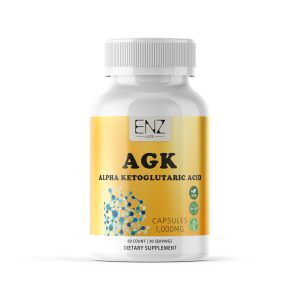
Alpha-Ketoglutaric Acid AKG Capsules
-
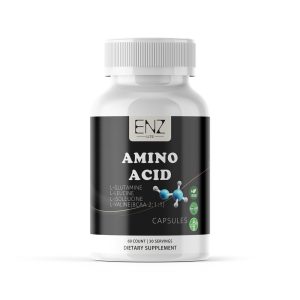
Amino Acids Capsules L-Glutamine L-Leucine L-Isoleucine L-Valine BCAA
-
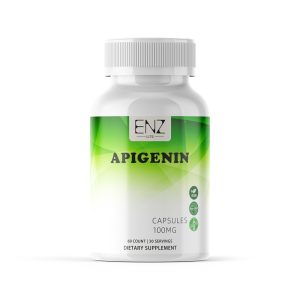
Apigenin Capsules 100mg
-
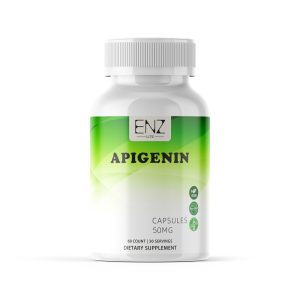
Apigenin Capsules 50mg
-
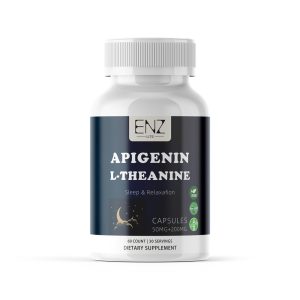
Apigenin Theanine Capsules Sleep & Relaxafion
-
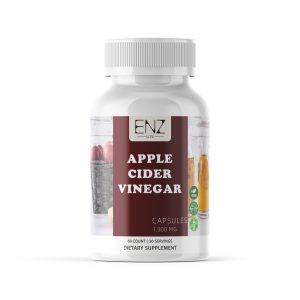
Apple Cider Vinegar ACV Capsules 1300mg
Industry Packaging Partner Spotlight: Ebifine Custom Packaging Solutions
A flawless supplement formulation will struggle on retail shelves if packaged in a cheap, generic carton. Ebifine specializes in high-end, custom packaging solutions, transforming dietary supplements, wellness collections, and skincare products into standout retail brands.
| Material Engineering | Food-contact safe, REACH-compliant paperboards, heavy-duty rigid greyboard, and recyclable kraft stocks |
| Finishing Craftsmanship | Soft-touch matte lamination, high-gloss UV, precision multi-level embossing, and metallic hot foil stamping |
| Color Management | Precision CMYK and Pantone Matching System (PMS) calibration across all packaging runs |
| Structural Protection | Custom die-cut internal foam inserts, corrugated crash-lock bases, and protective folding cartons |
| Industry Applications | High-end nutraceutical bottles, beauty wellness drops, and luxury cosmetic packaging |
Procurement Recommendation: Review our comprehensive capabilities on the Custom Cosmetic Packaging Solutions page to discover how custom secondary packaging elevates product perceived value while safeguarding your products throughout global shipping channels.
Direct Technical Comparison: Dosage Form Manufacturing Complexities
| Dosage Form | Production Velocity | Moisture Sensitivity Risk | Excipient / Binder Demand | Taste Masking Capability | Tooling & Setup Investment |
|---|---|---|---|---|---|
| Two-Piece Hard Capsules (Gelatin or Vegan HPMC) | Fast (Up to 150k / hr) | Low to Moderate; shell provides barrier | Minimal; requires only light flow agents | Excellent; completely encloses bitter powders | Low to Moderate; simple changeover rings |
| Compressed Tablets (Coated or Uncoated) | Extremely Fast (Up to 500k / hr) | Moderate; exposed porous edges | High; binders, lubricants, disintegrants | Moderate; requires secondary film coating | Moderate; custom hardened steel punch dies |
| Poured / Extruded Gummies (Pectin or Gelatin Base) | Moderate (Continuous deposit) | High; water activity must stay < 0.65 | High; sugar/syrup bases, acids, flavors | Exceptional; pleasant chewable taste | High; curing rooms, heated depositor lines |
| Liquid Tinctures & Drops (Oil or Water Emulsions) | Moderate (Liquid volumetric) | Extreme; prone to microbial growth | Low; carrier oils and clean emulsifiers | Poor; active herbs sit directly on tongue | Moderate; liquid filling cleanrooms |
Pros and Cons of Custom Contract Manufacturing vs. Stock Formulations
| Production Strategy | Commercial & Strategic Advantages | Operational Risks & Sourcing Demands |
|---|---|---|
| Custom Contract OEM Formulation (Full Bespoke Manufacturing) | Proprietary intellectual property that competitors cannot copy. Tailored active dosages based on direct clinical research. Complete control over clean-label excipients and organic certifications. Higher gross margins at scale (300% to 500% over manufacturing cost). | High Minimum Order Quantities (typically 3,000 to 10,000 bottles per run). Longer initial lead times for pilot batch validation (10 to 16 weeks). Higher upfront investment in stability testing and custom tooling. |
| Stock Private Label Formulation (Off-The-Shelf Pre-Made Formulas) | Fast time-to-market (ready to label and ship in 2 to 4 weeks). Accessible low MOQs (often starting at 250 to 500 bottles). Pre-existing stability testing and analytical records on file. | Zero market defensibility; dozens of brands sell the identical formula. Lower profit margins due to middleman distributor markups. Zero control over raw ingredient quality, origin, or excipient selection. |
Who Needs Custom Manufacturing vs. Who Can Rely on Stock White-Label
Every dollar committed to production inventory must align with your capital structure, distribution footprint, and brand positioning. Choosing the wrong manufacturing path can drain startup capital or leave enterprise brands with commodity products.
Who Must Invest in Custom Turnkey Manufacturing:
- Clinically Backed Specialty Wellness Brands: If your marketing relies on unique ingredient synergy—such as combining specific ratios of botanicals like Apigenin Capsules 50mg with targeted amino acids—stock private label catalogs cannot deliver your formula. You need custom blending.
- High-Growth Direct-to-Consumer (DTC) Brands Moving Over 5,000 Units/Month: Once your brand reaches volume, paying white-label distributor premiums erodes your margins. Transitioning to custom contract manufacturing cuts your unit cost by 40% to 60%, unlocking profit to fund customer acquisition.
- Practitioner-Grade Supplement Lines: Doctors, naturopaths, and elite sports nutrition brands require hypoallergenic, clean-label formulas with zero magnesium stearate, artificial colors, or cheap fillers. Custom manufacturing lets you specify organic rice extract blends and premium plant-based capsules.
Who Should Start with Stock Private Label Manufacturing:
- First-Time Entrepreneurs Testing Market Demand: If you have an unproven audience and a marketing budget under $10,000, do not tie up capital in a 5,000-bottle custom run. Buy 500 bottles of a proven stock formula, invest in high-end secondary packaging from Ebifine to elevate shelf appeal, and test your sales funnel before committing to custom formulations.
- Local Gyms, Spas, and Boutique Fitness Studios: If you are selling basic whey protein, daily multivitamins, or simple pre-workouts to local gym members, paying for custom formulation development is an unnecessary expense. A reliable stock formula with your logo is perfectly suited for on-site retail.
Catastrophic Sourcing Mistakes Brand Owners Make in Production
Factory Floor Advisory: The most catastrophic mistake new supplement founders make is trusting a manufacturer’s Certificate of Analysis without independent third-party lab verification. If an unvetted supplier provides adulterated raw materials and your brand releases that batch, you face full product liability, inventory destruction, and potential federal enforcement action.
- Ignoring Real-Time Stability Testing: Brand owners often assume a product will remain stable for two years simply because the individual ingredients are dry powders. In reality, chemical interactions between botanical acids and moisture can cause capsule shells to turn brittle, expand, or develop foul odors after six months in a warm warehouse. Always commission accelerated 6-month stability testing under real-world heat and humidity conditions.
- Underestimating Secondary Packaging Protection: Squeezing procurement budgets by choosing cheap, paper-thin folding cartons leads to crushed boxes, dented corners, and broken bottles on retail shelves. High-end retail accounts like Sephora, Whole Foods, and Target will reject entire shipments if outer packaging shows structural failure. Always specify heavy-gauge paperboard cartons with reinforced crash-lock bottoms.
- Failing to Account for Manufacturing Overage: When formulating delicate ingredients like vitamin C, probiotics, or B-complex vitamins, natural thermal degradation occurs during high-speed blending and shelf storage. Experienced formulators add a calculated 10% to 15% overage during blending to ensure that when an FDA inspector tests a bottle at month 22 of its 24-month shelf life, the active ingredients still meet 100% of the label claim.
- Skimping on Desiccant Sizing for Gummy Formulations: Gummy vitamins are hydroscopic matrices. If you pack gummies into plastic bottles without properly sized silica desiccants or foil induction seals, summer humidity will turn the contents into a melted, sticky block of gelatin that cannot be poured from the bottle.
Essential Sourcing Checklist: Auditing a Contract Manufacturer (CMO)
Before issuing a formal Purchase Order or transferring a 50% production deposit to any contract manufacturing organization, confirm these four technical criteria with your team:
1. Verified Third-Party cGMP Accreditations
Never rely on a manufacturer’s self-declaration of compliance. Require active, third-party audit certificates from internationally recognized registrars such as NSF International (NSF/ANSI 173 Dietary Supplement cGMP certification), UL, or the Natural Products Association (NPA). Request their most recent FDA Form 483 inspection history to confirm that federal investigators found no serious cleanliness or documentation deficiencies.
2. Open-Book Batch Production Record (BPR) Access
Your contract must state that your team has full access to the complete Batch Production Record upon completion of every run. This documentation must include raw material lot codes, scale calibration logs, cleanroom humidity records, in-process tablet weight checks, and release testing analytics. A manufacturer that treats batch records as proprietary secrets is hiding quality flaws.
3. Inline Automated Vision and Metal Detection Systems
Inspect the packaging line technology. Does the facility utilize high-speed vision inspection systems to verify that label lot codes, expiration dates, and induction seals are positioned accurately? Confirm that all tablets and capsules pass through functioning metal detectors with calibrated test wands (ferrous, non-ferrous, and stainless steel) to guarantee zero mechanical contamination.
4. Harmonizing Formulation Quality with Secondary Presentation
An exceptional supplement formula deserves exceptional presentation. Work with specialized packaging manufacturers to ensure outer cartons, rigid boxes, and instructional sleeves reflect your formula’s clinical quality. Integrating tactile soft-touch laminations, metallic hot stamping, and custom internal inserts through trusted providers like Ebifine ensures your finished product looks and feels like a luxury wellness experience.
Expert Practitioner Verdict & Commercial Roadmap
In our professional assessment, shortcuts in the vitamin supplement manufacturing process always cost more in the long run. The dietary supplement industry is transitioning away from hype-driven marketing toward verified clinical transparency. Today’s consumers read labels carefully, check testing data, and expect premium presentation.
Succeeding in this competitive landscape requires an uncompromising approach across all six steps of production. Source verified raw materials, demand multi-stage analytical testing, enforce tight cleanroom blending controls, and invest in secondary packaging that communicates quality. By treating your contract manufacturer as an engineering partner and elevating your presentation through tailored packaging from Ebifine, you build a resilient, compliant, and profitable supplement brand that wins on retail shelves for years to come.
Frequently Asked Questions
What are the most critical regulatory compliance standards in the vitamin supplement manufacturing process?
The foundational benchmark in the United States is FDA 21 CFR Part 111, which codifies Current Good Manufacturing Practice (cGMP) for dietary supplements. Internationally, manufacturers must align with ISO 22000, NSF/ANSI 173 certification, and regional pharmacopeia specifications to ensure purity, identity, and label claim accuracy.
How long does a full vitamin supplement manufacturing run take from concept to finished product?
A standard commercial production run requires 8 to 12 weeks. This timeline accounts for raw material sourcing and quarantine testing (2 to 3 weeks), formulation blending and encapsulation or tableting (2 to 3 weeks), in-process stability checks (1 week), and primary bottling alongside secondary packaging fabrication (3 to 4 weeks).
Why is secondary retail packaging as critical as capsule encapsulation in supplement manufacturing?
Secondary packaging protects primary containers from light and moisture degradation, ensures tamper evidence, provides required surface area for regulatory disclosures and Supplement Facts panels, and creates retail shelf impact that drives consumer purchase decisions.
What is the difference between wet granulation and direct blending in tablet manufacturing?
Direct blending mixes dry excipients and active botanical powders directly when particle sizes are naturally uniform. Wet granulation introduces a liquid binder to agglomerate fine powders into uniform granules, preventing ingredient separation and improving compressibility for heavy-duty tablet press operations.
Authoritative References & Regulatory Standards
- U.S. Food and Drug Administration (FDA): 21 CFR Part 111 Current Good Manufacturing Practice in Manufacturing, Packaging, Labeling, or Holding Operations for Dietary Supplements
- United States Pharmacopeia (USP): Dietary Supplements Compendium and Verification Program Standards
- NSF International: NSF/ANSI 173 Dietary Supplements Standard for Health and Product Integrity