
Every commercial nutraceutical brand director, clinical practitioner, and supplement founder must confront an uncomfortable manufacturing reality: the dietary supplement supply chain is rife with adulterated raw botanicals, degraded vitamins, sub-potent active claims, and catastrophic batch contaminations. In the modern regulatory landscape, having an aesthetically pleasing label design or an aggressive marketing campaign will not protect a business from an FDA Form 483 warning letter, severe retailer delisting on Amazon, or class-action product liability lawsuits. Ensuring product integrity requires mastering the foundational Quality Control Tests for Vitamin Supplements. Far too many brand owners believe that receiving a vendor-supplied piece of paper titled Certificate of Analysis is sufficient due diligence. In factory audits and analytical testing facilities, we know that blind faith in raw material brokers is a commercial death sentence. Establishing clinical credibility, complying with FDA 21 CFR Part 111 Current Good Manufacturing Practice (cGMP), and protecting human health demands a systematic testing cascade. From Fourier Transform Infrared Spectroscopy to Inductively Coupled Plasma Mass Spectrometry, we outline the nine mandatory Quality Control Tests for Vitamin Supplements that every credible brand must verify before releasing a single commercial bottle to the market.
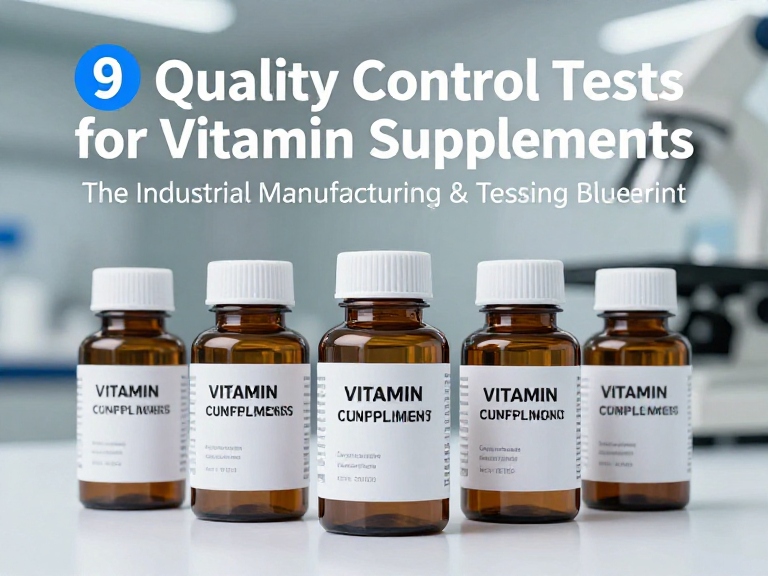
Quick Answer: The 9 Essential Quality Control Tests for Vitamin Supplements
To guarantee safety, label claim fidelity, and regulatory compliance, the manufacturing of dietary supplements must pass nine sequential Quality Control Tests for Vitamin Supplements: (1) Raw Material Identity Testing (100% verification of raw botanical and chemical fingerprints via FTIR, HPTLC, or NIR); (2) Active Ingredient Potency Assay (quantitative verification of vitamin concentrations via HPLC/UPLC to meet 100% of label claims); (3) Heavy Metal Contamination Screening (measuring toxic lead, arsenic, cadmium, and mercury down to parts-per-billion via ICP-MS under USP <2232>); (4) Microbiological Bioburden & Pathogen Testing (screening for Total Aerobic Plate Count, yeast, mold, and pathogens including Salmonella and E. coli under USP <2021/2022>); (5) Disintegration Verification (confirming tablets and capsules break down mechanically in simulated gastric fluid within 30 to 45 minutes under USP <2040>); (6) Dissolution & Bioavailability Testing (measuring the active molecular release rate into solution over time); (7) Physical Uniformity & Friability Testing (evaluating weight variation, hardness, and mechanical tumbling durability under USP <2091>); (8) Residual Solvent & Chemical Impurity Profiling (detecting toxic extraction solvents like hexane or methanol via Headspace GC-MS under USP <467>); and (9) Accelerated & Real-Time Stability Testing (subjecting finished packaging to elevated heat and humidity to validate real-world shelf-life expiration dates). Choosing a verified manufacturing partner like ENZ Pharmtech ensures that every single batch adheres to these analytical standards without cutting corners.
Article Directory
- The cGMP Testing Mandate: What Quality Control Actually Entails
- Quick Summary Table: The 9 Quality Control Tests at a Glance
- The 9 Quality Control Tests for Vitamin Supplements Analyzed
- Featured Partner: ENZ Pharmtech Contract Manufacturing & Testing
- Direct Technical Comparison: In-House Testing vs. 3rd-Party Verification vs. Skip-Lot Audits
- Pros and Cons of Comprehensive Full-Batch Testing Protocols
- B2B Commercial Decision Matrix: Auditing Your Contract Manufacturer
- Who Needs Full Analytical Testing vs. Who Can Utilize Streamlined Verification
- Costly Testing & Sourcing Mistakes That Trigger FDA Warning Letters
- Essential Sourcing Checklist: Auditing Laboratory Accreditations
- Expert Manufacturing Practitioner’s Final Verdict
- Frequently Asked Questions
- Authoritative References & Quality Standards
The cGMP Testing Mandate: What Quality Control Actually Entails
To evaluate Quality Control Tests for Vitamin Supplements with practical judgment, brand executives must understand statutory pharmaceutical frameworks. In the United States, dietary supplements are regulated under 21 CFR Part 111. This federal statute does not view quality control as an optional marketing badge; it is a legally binding operating standard. The FDA explicitly requires that dietary supplement manufacturers establish specifications for the identity, purity, strength, and composition of every finished batch, as well as limits on contaminants.
In most professional situations, the core failure of emerging wellness brands is confusing vendor documentation with verified empirical data. A raw material broker in another hemisphere may send a paper Certificate of Analysis stating that a powder is 99% pure ascorbic acid. However, federal cGMP guidelines strictly dictate that a manufacturer cannot rely on a vendor COA to establish the identity of a component. The manufacturing facility must perform at least one appropriate, scientifically valid test on 100% of incoming raw material lots to confirm molecular identity before that drum is permitted to cross from quarantine into dispensary cleanrooms.
From our experience on production facility floors, quality control is a multi-stage defensive net spanning three physical touchpoints:
- Incoming Raw Material Qualification: Verifying that the delivered raw drum matches chemical identity, contains no hidden excipients, and meets baseline microbiological and heavy metal safety specifications.
- In-Process Quality Control (IPQC): Testing physical parameters during active processing, such as monitoring capsule fill-weight variation every 15 minutes on automated encapsulation machines, or checking tablet hardness on high-tonnage rotary presses.
- Finished Product Release Testing: Subjecting final, sealed retail packaging to destructive analytical testing to ensure the finished formulation breaks down in the human stomach, releases active vitamins as claimed, and will remain shelf-stable throughout its two-year expiration period.
Executing these nine Quality Control Tests for Vitamin Supplements is the only mechanism that protects your brand from product recalls and guarantees biological efficacy to the consumer.
Quick Summary Table: The 9 Quality Control Tests at a Glance
| Test Phase & Name | Analytical Instrument / Methodology | Regulatory Compendial Standard | Primary Parameter Measured | Critical Commercial Failure Prevented |
|---|---|---|---|---|
| 1. Raw Material Identity | FTIR, HPTLC, NIR Spectroscopy | FDA 21 CFR § 111.75(a)(1) | Molecular fingerprint matching | Counterfeit or mislabeled raw botanical/chemical drums |
| 2. Active Potency Assay | HPLC, UPLC, UV-Vis Spectrophotometry | USP Monograph / AOAC Official Methods | Quantitative mg/serving active nutrient | Sub-potent products failing label claims & regulatory seizure |
| 3. Heavy Metal Screening | ICP-MS (Inductively Coupled Plasma) | USP <2232> / California Prop 65 | Lead (Pb), Arsenic (As), Cadmium (Cd), Mercury (Hg) | Neurotoxic poisoning, heavy fines, and retailer delisting |
| 4. Microbial Bioburden | Bioluminescence, Membrane Filtration, Petrifilm | USP <2021> & USP <2022> | Total plate count, yeast, mold, E. coli, Salmonella | Bacterial outbreaks, mold growth, product spoilage |
| 5. Disintegration Testing | Basket-Rack Assembly in 37°C Gastric Fluid | USP <2040> / Ph. Eur. 2.9.1 | Physical breakdown time (≤ 30–45 minutes) | Tablets passing through the human GI tract undissolved |
| 6. Active Dissolution Testing | Paddle / Basket Dissolution Apparatus | USP <711> / USP <2040> | % of active nutrient released into solution over time | Poor molecular bioavailability and ineffective formulations |
| 7. Physical Uniformity & Friability | Analytical Balances, Roche Friabilator, Hardness Testers | USP <2091> & USP <1216> | Weight variation (±5%), friability (<1.0%), thickness | Inconsistent pill dosing, crumbling tablets inside bottles |
| 8. Residual Solvent Screening | Headspace Gas Chromatography (GC-MS/FID) | USP <467> / ICH Q3C | Volatile extraction solvents (hexane, ethanol, acetone) | Carcinogenic and toxic solvent ingestion from herbal extracts |
| 9. Stability & Shelf-Life | Environmental Stability Chambers (40°C / 75% RH) | ICH Q1A(R2) / Arrhenius Modeling | Active potency degradation over 24 to 36 months | Expired products degrading mid-distribution chain |
The 9 Quality Control Tests for Vitamin Supplements Analyzed
1. Raw Material Identity Verification (100% Lot ID Testing)
The first defensive wall in any cGMP manufacturing facility is raw material identification. Under FDA statutes, manufacturers cannot simply inspect shipping labels or review paperwork. Every single container in a shipment must be sampled according to ANSI/ASQ Z1.4 statistical sampling protocols, and every composite lot must be positively identified before being cleared from quarantine.
In our testing laboratories, technicians utilize Fourier Transform Infrared Spectroscopy (FTIR) for synthetic vitamins and chemical salts. FTIR passes infrared radiation through the sample, measuring the vibrational frequencies of chemical bonds to produce a unique molecular spectrum. This spectrum is compared against certified reference standards from the United States Pharmacopeia (USP). If an overseas broker attempts to ship cheap maltodextrin masquerading as pure ascorbic acid, the FTIR absorption peaks immediately expose the adulteration. For complex botanical extracts, laboratories deploy High-Performance Thin-Layer Chromatography (HPTLC), which separates phytochemical components onto a silica plate, allowing chemists to compare visual chromatographic banding against certified botanical voucher specimens. This guarantees that an herbal delivery of echinacea or passiflora is authentic rather than a substitute species.
2. Active Ingredient Potency & Quantitative Assay Testing
A vitamin supplement must deliver 100% of the active nutrient claimed on its Supplement Facts panel throughout its stated shelf life. Producing a capsule that claims 600mg of an active antioxidant—such as Alpha Lipoic Acid ALA Capsules 600mg or a dedicated ALA Alpha Lipoic Acid Capsules 650mg—demands quantitative analytical verification. You cannot assume that because 600mg of raw powder went into the blending drum, 600mg of pure bioactive nutrient is delivered in each finished unit.
The gold standard for active potency testing is High-Performance Liquid Chromatography (HPLC) paired with Ultra-Violet (UV), Diode Array (DAD), or Mass Spectrometry (MS) detectors. HPLC dissolves the supplement matrix, forces the fluid under thousands of pounds of pressure through a packed chromatographic column, and separates active vitamin molecules from binders, excipients, and lubricants based on polarity. By comparing the retention time and peak area against certified calibration curves, chemists determine the exact milligram strength of water-soluble vitamins (B-complex, Vitamin C) and fat-soluble vitamins (A, D, E, K). In specialized functional complexes like our Alpha-Ketoglutaric Acid AKG Capsules, HPLC testing confirms that active biological salts have not decomposed during high-speed encapsulation.
3. Heavy Metal Contamination Analysis (ICP-MS Screening)
Heavy metal contamination is the single fastest route to catastrophic regulatory enforcement, toxic consumer exposure, and brand destruction. Soil minerals, agricultural runoff, and chemical extraction agents often contaminate raw botanicals and mineral salts with elemental poisons: lead, arsenic, cadmium, and mercury. If your brand sells in California, Prop 65 enforces extraordinarily strict maximum allowable dose levels (MADLs), limiting lead exposure to a fraction of a microgram per day (0.5 μg/day).
Modern quality assurance mandates testing via Inductively Coupled Plasma Mass Spectrometry (ICP-MS) under compendial guidelines outlined in USP <2232>. The laboratory digests the vitamin sample in concentrated trace-metal-grade nitric acid inside a closed microwave digestion vessel at high temperature and pressure. The digested liquid is then nebulized into an argon plasma torch burning at 6,000 to 10,000 Kelvin. The plasma strips electrons from the elements, ionizing them so the mass spectrometer can detect and quantify individual heavy metal isotopes down to parts-per-billion (ppb) or parts-per-trillion (ppt) concentrations. In our testing of mineral supplements, cheap calcium carbonates and zinc compounds frequently test high for lead; ICP-MS testing prevents these toxic raw lots from ever entering finished production.
4. Microbiological Bioburden and Specific Pathogen Screening
Vitamin supplements are ingested organic matrices. If moisture control fails during manufacturing or raw materials are harvested in unhygienic conditions, capsules and gummies turn into bacterial and fungal incubators. Contamination with pathogenic microorganisms can cause severe gastrointestinal illness or systemic infection in vulnerable consumers.
Microbiological screening must strictly adhere to USP <2021> (Microbiological Enumeration Tests) and USP <2022> (Tests for Specified Microorganisms):
- Total Aerobic Microbial Count (TAMC): Standard limits typically mandate less than 10,000 Colony Forming Units per gram (CFU/g) for finished oral supplements.
- Total Combined Yeasts and Molds Count (TYMC): Standard acceptable limits require less than 1,000 CFU/g.
- Specified Pathogen Exclusion: The sample must demonstrate zero presence (negative in 10 grams) of dangerous pathogens: Escherichia coli, Salmonella species, Staphylococcus aureus, and Pseudomonas aeruginosa.
This testing is especially critical for chewable confectionery formats, such as an Adult Vitamin B Gummy B-Complex Vitamin A Vitamin C Zinc or an immune-focused Adult Zinc Gummy Vitamin D3 Echinacea, where moisture activity ($a_w$) must be kept below 0.65 to inhibit environmental mold germination.
5. Solid Dosage Form Disintegration Verification (USP <2040>)
A compressed vitamin tablet or filled hard-shell capsule can possess perfect chemical potency, but if it fails to disintegrate in the human digestive system, it is medically worthless. If tablet compression tonnage is set too high, or if excessive hydrophobic lubricants (such as magnesium stearate) are blended into the formula, the tablet will pass completely intact through the gastrointestinal tract and into the sewer system.
Disintegration testing follows compendial standards under USP <2040>. Six tablets or capsules are placed into a specialized basket-rack assembly fitted with a wire mesh screen at the bottom. The assembly moves up and down mechanically through a immersion bath of simulated gastric fluid (0.1 M HCl) maintained at physiological body temperature ($37^\circ\text{C} \pm 2^\circ\text{C}$). Under standard USP dietary supplement specifications, uncoated vitamin tablets and hard gelatin or vegetarian HPMC capsules must completely break down into a soft mass with no palpable firm core within 30 to 45 minutes. If fragments remain on the wire mesh after 45 minutes, the batch fails inspection and cannot be released.
6. Active Dissolution and Bioavailability Kinetics (USP <711>)
While disintegration verifies the physical breakdown of a pill, dissolution testing measures the rate at which the active nutrient molecules break free from the carrier matrix and dissolve completely into biological fluids. Disintegration is a prerequisite for dissolution, but it does not guarantee that the active nutrient is bioavailable.
Using automated USP Apparatus 1 (Baskets) or Apparatus 2 (Paddles), the dosage unit is stirred inside calibrated vessels filled with dissolution media simulating stomach acid or upper intestinal fluids. At strict time points (e.g., 15, 30, 45, and 60 minutes), automated autosamplers draw fluid aliquots. These aliquots are injected into an HPLC system to quantify the exact percentage of active vitamin dissolved into solution. Compendial monographs typically demand that at least 75% of the labeled active nutrient ($Q$) dissolves within 45 minutes. For complex cognitive formulas like our Alpha GPC Choline Capsules or multi-pathway blends like Alpha Focus Nootropic Capsules, dissolution profiles verify that active bioactives release predictably for optimal neurological uptake.
7. Physical Uniformity, Friability, and Weight Variation Testing
Consistency is the hallmark of professional pharmaceutical-grade manufacturing. When a consumer takes a capsule from the top of the bottle, it must deliver the exact same physical and chemical payload as a capsule taken from the bottom. Physical uniformity testing evaluates whether high-speed machinery operates in mechanical balance throughout a 500,000-unit production run.
Physical quality control encompasses three non-destructive and semi-destructive procedures:
- Weight Variation (USP <2091>): Technicians weigh 20 individual dosage units on analytical balances calibrated to 0.1 mg. The individual masses are checked against statistical standard deviation tables. No more than two individual units may deviate from the average weight by more than 5% to 10%, and no unit may deviate by more than double that threshold.
- Tablet Hardness and Thickness: Measured via automated electronic jaw testers that crush tablets diametrically, recording the force in kiloponds (kp) or Newtons (N) to ensure structural durability.
- Friability Testing (USP <1216>): Tablets are placed into a rotating drum (the Roche Friabilator) that drops them 6 inches on each revolution for 100 turns. The tablets are de-dusted and reweighed. To pass commercial transport standards, the total mass lost to chipping, crumbling, or capping must be less than 1.0% of initial mass.
8. Residual Solvent and Extraction Impurity Screening (USP <467>)
Many of the most popular botanical ingredients in vitamin and nootropic formulations—such as standardized herbal extracts, polyphenol concentrates, and specialized stamina blends like Private: Alpha Male Tongkat Ali Capsules 5 in 1—require organic chemical solvents to extract and concentrate the active phytochemicals from raw plant biomass. Common extraction solvents include ethanol, methanol, isopropanol, ethyl acetate, acetone, and hexane.
If the chemical manufacturing plant fails to properly purge these solvents during vacuum drying, toxic chemical residues remain trapped within the raw powder. Under USP <467> and ICH Q3C Guidelines, residual solvents are categorized into three toxicological classes:
- Class 1 Solvents (Carcinogens): Solvents like benzene and carbon tetrachloride are strictly prohibited in dietary supplements.
- Class 2 Solvents (Systemic Toxins): Solvents like hexane, methanol, and acetonitrile carry strict concentrations limits (e.g., hexane is restricted to ≤ 290 ppm).
- Class 3 Solvents (Low Toxic Potential): Solvents like ethanol and acetone must not exceed 5,000 ppm (0.5%).
Testing requires Headspace Gas Chromatography coupled to Flame Ionization Detection or Mass Spectrometry (GC-MS/FID). The sample is sealed in a glass vial and heated; the volatile solvents vaporize into the headspace gas, which is injected into the GC column to identify and quantify toxic volatile chemicals down to fractional parts-per-million.
9. Accelerated and Real-Time Shelf-Life Stability Testing
A vitamin product must meet 100% of its Supplement Facts panel claims not only on the day it exits the blister-pack or bottling line, but on its final day of expiration two or three years later. Active vitamins—especially Vitamin C, thiamine ($B_1$), Vitamin D, and folic acid—undergo natural chemical oxidation and thermal degradation over time.
Validating an authentic expiration date requires structured stability testing following International Council for Harmonisation (ICH) Q1A(R2) protocols:
- Accelerated Stability Testing: Finished, sealed retail bottles are placed inside calibrated environmental chambers maintained at $40^\circ\text{C} \pm 2^\circ\text{C}$ and $75\% \pm 5\%$ Relative Humidity for six continuous months. Pulling samples at 0, 1, 2, 3, and 6 months and running full HPLC assay and microbial testing models two years of ambient warehouse aging via the Arrhenius equation.
- Real-Time Ambient Stability: Storing products at $25^\circ\text{C} \pm 2^\circ\text{C}$ and $60\% \text{ RH}$ across 12, 24, and 36 months to verify real-time degradation kinetics.
Stability testing dictates formulation overages: experienced formulators add calculated 10% to 15% manufacturing overages during cleanroom blending so that when an FDA inspector tests a bottle at month 23, the active ingredients still meet 100% of label claims. This stability rigor is vital for sleep and recovery formulations, such as our Adult Best Melatonin Gummy 5mg, specialty botanical blends like Adult Melatonin Gummies Passiflora Vitamin B6, or complex joint matrices like Advanced Joint Support Gummies Methylsulfonylmethane.
Turnkey Manufacturing & Testing: ENZ Pharmtech Contract Solutions
Navigating the analytical complexities, expensive laboratory machinery, and rigorous compliance demands across all nine Quality Control Tests for Vitamin Supplements requires an established, research-grade manufacturing partner. ENZ Pharmtech provides turnkey private-label and custom formulation manufacturing, supporting emerging startups and global brands with complete compliance backing.
| Corporate Experience | Over 20 years of pharmaceutical-grade nutraceutical formulation, blending, and analytical testing |
| Minimum Order Flexibility | Industry-leading Private Label Supplements No Minimum Order solutions for agile brand launches |
| Testing & Compliance | Full in-house and accredited third-party validation for identity, HPLC potency, ICP-MS metals, and microbials |
| Dosage Capabilities | Two-piece hard capsules (gelatin & vegan HPMC), compressed tablets, softgels, powders, and pectin/gelatin gummies |
| Category Coverage | Vitamins & minerals, herbal botanicals, sports nutrition, cognitive nootropics, immune support, and joint health |
Procurement Recommendation: Eliminate manufacturing uncertainty by leveraging ENZ Pharmtech’s cGMP facilities. Sourcing certified private label runs ensures that every production unit is backed by empirical laboratory testing, verified Certificates of Analysis, and complete regulatory compliance from pilot batch to multi-container distribution.
Direct Technical Comparison: In-House Testing vs. 3rd-Party Verification vs. Skip-Lot Audits
| Quality Control Model | Analytical Rigor & Defensibility | Cost per Production Batch | Turnaround Time Impact | Regulatory Risk Profile | Best Commercial Fit |
|---|---|---|---|---|---|
| Full 100% In-House Testing (Manufacturer-Owned Analytical Labs) | High (When certified under ISO/IEC 17025) | Low to Moderate (Internal overhead) | Fast (3 to 5 business days) | Low (Full control over batch release) | High-volume established brands moving 10,000+ bottles/month |
| ISO 17025 Third-Party Lab Verification (Independent Analytical Testing) | Maximum (Highest legal & retailer credibility) | Moderate to High ($800 – $2,500/batch) | Moderate (7 to 14 business days) | Zero (Completely unbiased independent data) | Retail brand launches, Amazon compliance, clinical practitioner lines |
| Vendor COA Reliance with Skip-Lot Audits (Periodic Confirmatory Retesting) | Moderate (Acceptable only for non-identity specs) | Low ($200 – $500 periodic audit fee) | Immediate (Documentary clearance) | Moderate to High (Vulnerable to vendor drifts) | High-volume commodity components (e.g., microcrystalline cellulose) |
| Unverified Paper COA Acceptance (Zero Physical Testing) | Zero (Scientifically & legally indefensible) | Zero (Zero testing expense) | Instantaneous | Extreme (Immediate FDA 21 CFR Part 111 violation) | Unregulated grey-market operators; guaranteed regulatory failure |
Pros and Cons of Comprehensive Full-Batch Testing Protocols
| Testing Strategy | Strategic & Commercial Advantages (Pros) | Operational Limitations & Expenses (Cons) |
|---|---|---|
| Comprehensive 9-Step Full-Batch Testing (Complete Analytical Release) | Bulletproof legal defense against FDA inspections and warning letters. Guaranteed acceptance by major retail platforms (Whole Foods, Amazon, Target). Complete elimination of toxic heavy metal liability and Prop 65 lawsuits. Reinforces clinical trust with healthcare providers and discerning consumers. Ensures formulation stability and active potency throughout full shelf life. | Adds $1,200 to $3,500 in analytical testing overhead per production lot. Extends batch release turnaround by 10 to 14 working days. Requires holding quarantine inventory while awaiting laboratory clearances. |
| Minimalist “Identity Only” Testing (Statutory Minimum Compliance) | Low upfront testing expenses; maximizes immediate gross profit margins. Faster inventory turnaround from blending directly to fulfillment warehouse. | High risk of failing stability assays before stated expiration dates. Vulnerable to unexpected heavy metal spikes in unvetted mineral lots. Immediate retail delisting if Amazon or third-party auditors conduct spot tests. |
B2B Commercial Decision Matrix: Auditing Your Contract Manufacturer
For brand founders, procurement managers, and corporate executives sourcing manufacturing partners, determining whether a facility genuinely conducts Quality Control Tests for Vitamin Supplements requires looking past marketing brochures. Every contract manufacturer claims to be cGMP certified; few maintain the multi-million-dollar analytical instrumentation required to perform full testing in-house.
Three Mandatory Laboratory Audits Before Signing a Manufacturing Contract:
- 1. Demand to Inspect the Analytical Instrument Bay: When touring a contract manufacturing facility, ask to see the testing laboratory. Look for operational HPLC, UPLC, and GC-MS systems from tier-1 manufacturers (Waters, Agilent, Shimadzu). If the facility operates 10 encapsulation machines but their quality laboratory only has an analytical balance and a pH meter, they are farming out all testing to third parties or skipping testing entirely.
- 2. Review Finished Master Manufacturing Records (MMR): Request an anonymized, executed Batch Production Record (BPR) from a previous commercial run. Verify that the batch record includes physical sign-offs from the Quality Assurance Director for: (a) raw material FTIR identity spectra; (b) in-process capsule weight charts with standard deviations; (c) third-party analytical assay chromatograms; and (d) microbiological plating results. If the batch was released before testing data arrived, the facility operates in violation of cGMP.
- 3. Audit the Out-of-Specification (OOS) Investigation Log: In a real analytical laboratory, testing failures happen: a raw material fails identity, or a blend shows sub-potent vitamin distribution. Ask to inspect their OOS log. A facility that claims they have never had an OOS result in five years is hiding data. An honest, compliant manufacturer has structured OOS procedures under FDA guidelines to investigate failures, identify root causes, and reject non-compliant inventory.
Who Needs Full Analytical Testing vs. Who Can Utilize Streamlined Verification
Every dollar allocated to quality control must balance consumer safety, regulatory exposure, and product margins. Different distribution channels and formulations demand different analytical depth.
Who Must Invest in Full-Spectrum 9-Stage Testing:
- Brands Selling on Amazon, iHerb, and National Retail Chains: Modern retail platforms enforce mandatory third-party testing programs. Amazon mandates that all dietary supplement sellers provide verified Certificates of Analysis from an ISO/IEC 17025 accredited laboratory confirming active ingredient potency and heavy metal safety. Attempting to sell without full testing will result in immediate account suspension.
- Clinical Practitioner and Functional Medicine Lines: Doctors, naturopaths, and clinical nutritionists demand pharmaceutical rigor. Sourcing practitioner-grade supplements requires verified dissolution rates, zero artificial excipients, and full transparency.
- Brands Formulating Multi-Botanical and Specialty Blends: Herbal ingredients carry high natural variance and elevated risk of heavy metal bioaccumulation. Formulations combining botanicals with active minerals must undergo complete testing on every lot.
Who Can Utilize Streamlined Testing Protocols:
- Brands Sourcing Pre-Tested, Pre-Qualified Private Label Stock Formulas: If you are launching a startup using pre-formulated stock lines from a reputable, certified manufacturer like ENZ Pharmtech, the base formulation has already undergone comprehensive method validation and stability testing. The manufacturer conducts routine identity, microbial, and release potency testing, allowing new brands to enter the market with low minimum orders and minimized testing expenses.
Costly Testing & Sourcing Mistakes That Trigger FDA Warning Letters
Regulatory Enforcement Advisory: The single most frequent citation in FDA dietary supplement warning letters is violation of 21 CFR § 111.75: failure to conduct at least one appropriate test to verify the identity of any component that is a dietary ingredient. You cannot contract away your legal liability; the brand whose name appears on the label bears ultimate legal responsibility for product adulteration.
- Testing Finished Products for “Dry Weight” Instead of Serving Size: Formulators frequently design products where a serving is two or three capsules. Analytical chemists must report potency per labeled serving size, not merely per gram of bulk powder. Discrepancies between bulk powder assay concentrations and finished capsule fill weights lead to failed retail audits.
- Using Non-Specific Analytical Methods for Vitamin Quantification: Utilizing non-specific spectrophotometric UV-Vis absorption to quantify Vitamin C in a complex multi-ingredient formula containing citrus bioflavonoids and herbal extracts will yield massively inflated, false-positive results. The bioflavonoids absorb light at identical wavelengths. Complex matrices demand chromatographic separation via HPLC to resolve the active vitamin from interfering botanical compounds.
- Ignoring Matrix Interference in Gummy Testing: Gummy vitamins are composed of sticky gelatin, pectin, and corn syrups. Standard extraction protocols used for hard tablets fail to release active vitamins from the cross-linked gummy matrix, resulting in artificial 50% assay readings. Testing laboratories must use specialized enzymatic digestion protocols to dissolve the hydrocolloid gummy base prior to HPLC injection.
- Skipping Heavy Metal Testing on “Certified Organic” Botanicals: Brand founders often assume that because an herbal powder carries a USDA Organic seal, it is free from heavy metals. This is a dangerous fallacy. Organic certification governs pesticide and synthetic fertilizer use; it does not regulate naturally occurring lead, arsenic, or cadmium absorbed from mineral-rich soils. Organic herbs routinely fail Prop 65 lead limits if not screened via ICP-MS.
- Failing to Account for Thermal Degradation in Blending: High-speed industrial ribbon blenders generate significant frictional heat. Blending heat-sensitive vitamins (such as thiamine or active probiotics) for 45 minutes can destroy 30% of the active potency before the powder ever reaches the tablet press. Blending cycles must be validated for time and temperature limits.
Essential Sourcing Checklist: Auditing Laboratory Accreditations
Before releasing payment for a finished production batch, require your manufacturing partner to provide an analytical data packet satisfying these four technical benchmarks:
1. ISO/IEC 17025 Laboratory Accreditation
Ensure that all analytical testing is performed by a laboratory accredited under ISO/IEC 17025:2017 (General requirements for the competence of testing and calibration laboratories). ISO 17025 accreditation verifies that the laboratory uses calibrated instrumentation, validated testing methodologies, and participates in blind proficiency testing programs.
2. Validated Compendial Testing Methods
Confirm that the laboratory utilizes recognized compendial methodologies published by:
- United States Pharmacopeia (USP): The legal standard for dietary supplement monographs, disintegration, and dissolution.
- AOAC INTERNATIONAL: Official Methods of Analysis for agricultural, food, and nutritional testing.
- European Pharmacopoeia (Ph. Eur.): Harmonized standards for botanical quality and residual solvent limits.
Never accept unvalidated, proprietary in-house test methods unless the manufacturer provides full analytical method validation documentation demonstrating linearity, accuracy, precision, and specificity.
3. Batch-Specific Traceability and Lot Matching
The Certificate of Analysis must clearly state your exact commercial production batch number, manufacturing date, and expiration date. Ensure the report includes raw data printouts or chromatograms with baseline-resolved peaks, rather than a generic checklist stating “Pass” or “Conforms.”
4. Comprehensive Formulation Partnership
Quality control starts with formulation design. Work with manufacturers who understand ingredient synergy, excipient compatibility, and dosage optimization. Sourcing through experienced partners like ENZ Pharmtech ensures that your products are formulated from day one to pass all nine quality control gates smoothly, minimizing production scrap and maximizing shelf stability.
Expert Manufacturing Practitioner’s Final Verdict
In our professional assessment across decades of pharmaceutical and nutraceutical production, cutting corners on Quality Control Tests for Vitamin Supplements is the single most dangerous mistake a wellness brand can make. Squeezing procurement budgets by skipping third-party testing or accepting unverified vendor paperwork creates an illusion of profit that collapses the moment a batch fails an FDA audit, triggers a retailer delisting, or harms a consumer.
Quality control is not an overhead expense; it is a brand asset. Sourcing through proven, scientifically disciplined manufacturing partners like ENZ Pharmtech—who enforce 100% raw material identity verification, quantitative HPLC assay potency, ICP-MS heavy metal detection, and strict USP dissolution standards—protects your brand equity and ensures every single product you ship delivers uncompromised safety, clinical potency, and consumer trust.
Frequently Asked Questions
What are the most critical quality control tests for vitamin supplements required by law?
Under FDA 21 CFR Part 111 cGMP regulations, manufacturers are legally mandated to conduct 100% identity testing on every incoming raw material lot, verify active ingredient strength against label claims, screen for microbial bioburden and specific pathogens, and confirm heavy metal contamination stays below toxicological limits. Disintegration and dissolution testing are also mandatory under USP compendial standards to ensure physiological absorption.
Can a brand owner rely exclusively on a supplier Certificate of Analysis (COA) without laboratory testing?
No. Under FDA cGMP guidelines, relying blindly on a vendor Certificate of Analysis for active ingredient identity is an immediate regulatory violation. While brands may rely on a vendor COA for certain non-identity tests (such as residual solvents or specific mineral assays), they may only do so after conducting formal vendor qualification audits and independently validating the supplier laboratory through periodic re-testing.
What is the difference between disintegration testing and dissolution testing?
Disintegration testing (USP <2040>) measures the mechanical breakdown of a solid dosage form (tablet or capsule) into soft granules within a simulated fluid matrix, typically requiring breakdown in under 30 to 45 minutes. Dissolution testing (USP <711>) is an analytical quantitative assay that measures the exact percentage rate at which the active nutrient molecules dissolve into solution over time, directly correlating with human bioavailability.
Why do gummy vitamin supplements require unique quality control testing compared to capsules?
Gummy vitamins have high water activity (aw), sugars, and hydrocolloid bases (pectin or gelatin) that expose active vitamins to thermal degradation during hot-pour depositing. They require strict water activity testing (aw < 0.65 to prevent mold), higher manufacturing overages to offset heat loss, and specialized extraction protocols to liberate vitamins from sticky pectin matrices prior to HPLC assay quantification.
Authoritative References & Quality Standards
- U.S. Food and Drug Administration (FDA): 21 CFR Part 111 Current Good Manufacturing Practice in Manufacturing, Packaging, Labeling, or Holding Operations for Dietary Supplements
- United States Pharmacopeia (USP): Compendial Standards for Dietary Supplement Testing, Disintegration (<2040>), and Heavy Metals (<2232>)
- AOAC INTERNATIONAL: Official Methods of Analysis for Validated Botanical, Vitamin, and Nutritional Assay Quantifications